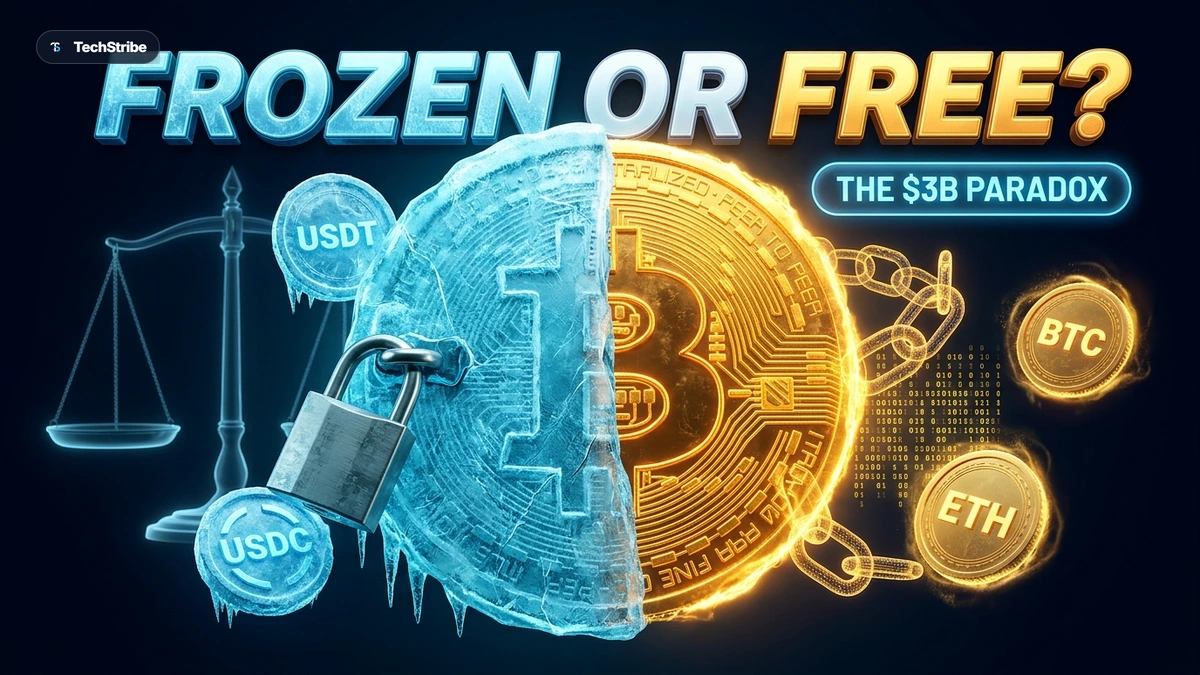
For over a decade, cryptocurrency’s core ideological premise was absolute censorship resistance: no central authority can freeze your funds. Yet within hours of the $6.3B Binance heist, stablecoin issuers and emergency councils immobilized nearly half the stolen assets—to widespread acclaim. This paradoxical response brings the decentralization debate to the forefront of modern finance.
For years, crypto’s pitch had one sentence at its center: nobody can freeze your money.
Then, on October 29, 2026, a thief took $6.3 billion from Binance, and within hours some of the industry’s biggest names did exactly that. They froze nearly half of it. Almost nobody complained.
That reaction is what makes the Binance hack freeze so interesting. It forces a question the industry has dodged for years: if companies and councils can switch off crypto, how decentralized is crypto? This guide separates the legal questions from the philosophical ones.
The Freeze at a Glance
| Detail | What is reported |
|---|---|
| Total stolen | About $6.3 billion (Binance); $6.36 billion (TRM Labs) |
| Frozen | About $3 billion per Binance, close to half of the total |
| Issuers | Tether froze ~$1.567B USDT and Circle ~$823M USDC |
| Others | Ripple, World Liberty Financial ($27.8M USD1) and Arbitrum Security Council (~$30.5M) |
| Not frozen | Bitcoin and ether on their base networks, including ~$1.4B in BTC split across 19 wallets |
| Official attribution | The FBI confirmed North Korea’s TraderTraitor was responsible |
Three Kinds of Freeze, Three Kinds of Power
“Freezing crypto” is not a uniform technical action. The Binance counter-offensive employed three distinct control mechanisms, each carrying different legal and philosophical implications:
| Type | Example | Where the power comes from |
|---|---|---|
| Issuer freeze | Tether and Circle blacklisting addresses holding USDT and USDC | Controls built into the token’s code and company terms |
| Network freeze | Arbitrum’s Security Council moving ETH and ARB to a locked address | Emergency powers held by a 12-member elected council |
| Application pause | Aave pausing new borrowing and supply | The protocol’s internal algorithmic risk controls |
Issuers: Money With an Off Switch
Stablecoins such as USDT and USDC are issued by centralized corporations with smart contract backdoors that can blacklist specific addresses. Tether can also burn frozen tokens and issue replacements. Circle can arrange for equivalent value to be returned through an authorized process.
Networks: A Council With Emergency Powers
Arbitrum is a layer-2 rollup, and its 12-member Security Council took the unprecedented step of moving the attacker’s ETH and ARB into an unspendable address nobody controls. Only the council or an Arbitrum DAO governance vote can release it.
This was not without precedent: the same council froze roughly $71 million of ETH after the KelpDAO exploit in April 2026. However, confiscating on-chain assets without the owner’s private key signature represents a major escalation beyond simple token contract blacklisting.
What Nobody Could Freeze
Bitcoin and ether on their native base networks have no central issuer and no governing council with an emergency freeze key. Elliptic estimated that about $3.33 billion remained in assets that no entity could immobilize.
The freeze worked exclusively on the layers of crypto that were already centralized. It did not—and could not—touch the core decentralized base layers.
The Legal Questions
Legal experts quoted across the industry agreed the emergency freezes were broadly justified to stop state-sponsored cybercrime. However, several foundational legal questions remain unanswered:
| Question | The issue |
|---|---|
| Who has the authority? | Issuers can act under contract terms, sanctions obligations, or requests from authorities. Those powers do not legally adjudicate who owns the money. |
| Is a freeze a recovery? | No. A freeze halts movement. Returning funds requires proving ownership and may require court orders across multiple countries. |
| Is it applied equally? | Circle’s leadership previously stated it freezes USDC only under court or law enforcement direction. Smaller hack victims rarely receive rapid intervention, prompting questions about two-tier enforcement. |
| What if a freeze is wrong? | Issuers face liability for wrongful blacklisting and shoulder significant operational compliance exposure. |
| Who sets the standard? | Industry auditors like CertiK argue for clearer international statutory frameworks to protect issuers acting in good faith. |
The Philosophical Debate
The Case That It Was Necessary
- Victim Protection: Stolen funds belonged to millions of retail and institutional depositors. Letting state-sponsored hackers fund nuclear weapons programs benefits nobody.
- Pragmatic Security: Market makers argue that allowing malicious actors to exploit smart contracts with impunity weakens the entire crypto ecosystem.
- Centralized Attack Vector: The breach exploited a centralized exchange’s corporate infrastructure. Centralization was both the vulnerability and, via issuer freezes, the rescue mechanism.
The Case That It Is a Warning
- Precedent Risk: Powers created to halt criminals can eventually be used against political dissidents or unapproved transactions.
- Erosion of Trustlessness: If a governing council or corporate issuer can confiscate balances, users must trust human administrators—the exact counterparty risk crypto was invented to eliminate.
- Two-Tier Justice: Major institutions receive instant off-chain coordination, while smaller victims are left to navigate bureaucratic court filings.
So, Is Crypto Decentralized?
The honest reality is that decentralization is a spectrum rather than a binary switch:
- Base Layer (BTC & ETH): Remain immutable and censorship-resistant. Nobody could freeze the $1.4B in Bitcoin.
- Asset Layer (Stablecoins): Heavily centralized and custodial, containing administrative backdoors.
- Rollup Layer (Layer-2s): Often retain multisig councils with emergency intervention powers during their early maturity stages.
What It Means for Everyday Users
- Understand Token Custody: Holding USDT or USDC in a self-custody cold wallet does not protect you from issuer blacklisting.
- Do Not Assume Neutrality: Issuer intervention can safeguard stolen funds, but it proves administrative keys exist.
- Monitor Governance Policies: Keep track of whether protocols freeze based strictly on judicial subpoenas or executive discretion.
Quick Glossary
| Term | Plain meaning |
|---|---|
| Blacklist | An issuer’s on-chain block on a specific address preventing its tokens from moving |
| Security Council | An elected multisig group with emergency intervention powers over a network or rollup |
| DAO vote | A governance consensus vote executed by decentralized token holders |
| Base layer | The primary underlying blockchain network itself (Layer 1), such as Bitcoin or Ethereum |
Frequently Asked Questions
Did the Binance hack prove crypto isn’t decentralized?
Not entirely. It demonstrated that stablecoins and layer-2 networks contain centralized admin keys, while base-layer Bitcoin and Ethereum remain completely uncensorable.
Who froze the stolen Binance funds?
Tether, Circle, Ripple, World Liberty Financial, and Arbitrum’s Security Council all froze assets. Aave paused several lending pools as a precaution.
Why can Tether and Circle freeze USDT and USDC?
Their smart contracts include built-in admin functions enabling the contract owner to blacklist any Ethereum or Solana address from transferring tokens.
Is freezing stolen crypto legal?
Issuers act under their terms of service, sanctions compliance, and emergency law enforcement requests. However, returning funds formally requires court-ordered ownership determination.
What is the Arbitrum Security Council?
It is a 12-member elected council holding 9-of-12 multisig emergency powers to protect the Arbitrum network during critical zero-day vulnerabilities or major exploits.
Why didn’t everyone get the same help?
Smaller hack victims frequently report that stablecoin issuers require formal subpoenas before intervening, highlighting an ongoing debate around institutional double standards.
Can Bitcoin be frozen?
No on-chain mechanism exists to freeze native Bitcoin. However, centralized exchanges can freeze accounts if the attacker deposits funds onto regulated platforms.