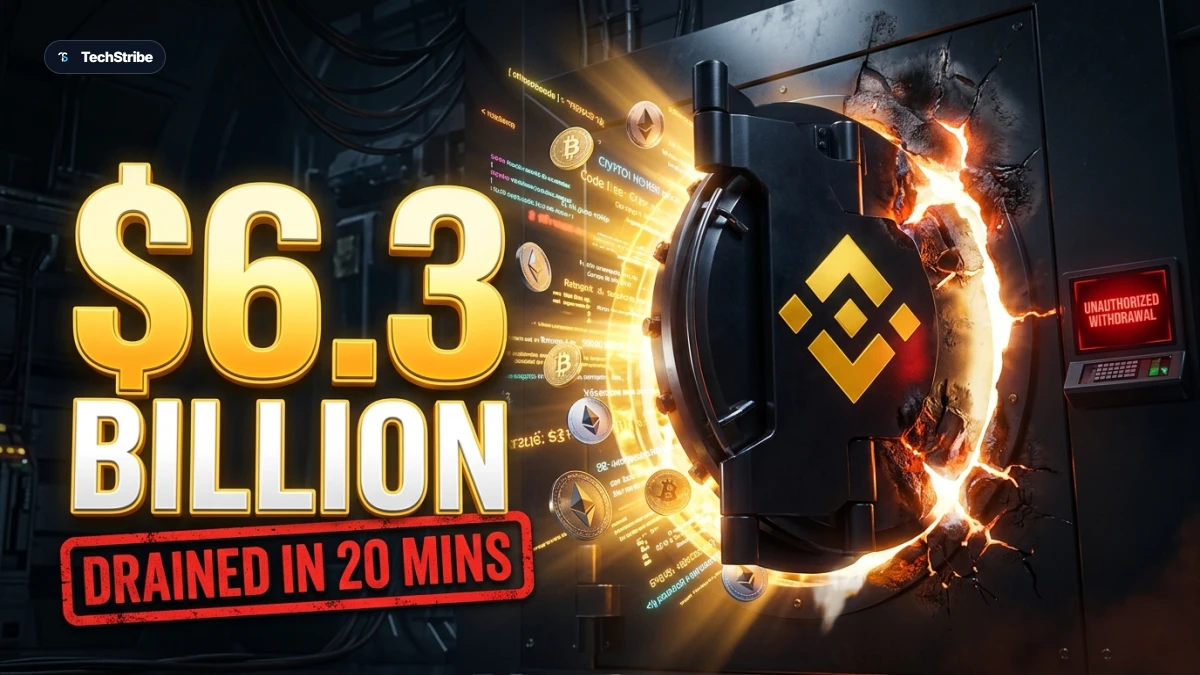
Twenty minutes. That is approximately how long it took an attacker to drain an estimated $6.3 billion from Binance hot wallets on the night of October 29, 2026. There was no ransom note, no public countdown, and no cryptographic breakthrough — just a torrent of unauthorized withdrawal authorizations executed across ten separate blockchains while global markets were wrapping up their day.
The incident represents the largest crypto hack in recorded history — more than four times the size of the $1.5 billion Bybit theft in February 2025. Whether you are an infrastructure engineer, a systems architect, or a security practitioner, understanding the exact attack sequence and structural implications is essential.
The Binance Hack at a Glance
| Target Platform | Binance, the world’s largest cryptocurrency exchange by trading volume. |
| Date & Time | Evening of October 29, 2026 (~20:05 UTC). |
| Estimated Impact | ~$6.3 billion (Binance estimate); $6.36 billion (TRM Labs). |
| Execution Velocity | The bulk of illicit transfers occurred within ~20 minutes. |
| Blockchains Affected | 10 distinct chains (including Ethereum, XRP Ledger, BSC, and Solana). |
| Frozen Assets | ~$3.0 billion quarantined, including >$2.3B in USDT and USDC. |
| Emergency SAFU Fund | ~15,000 BTC (~$1.17 billion at current spot price). |
| Attribution Assessment | TRM Labs and Chainalysis assess North Korea’s TraderTraitor group as the culprit. |
Timeline: What Happened on October 29
Because on-chain telemetry and exchange disclosures arrived across multiple global timezones, the timeline below reflects verified UTC markers:
| Time (UTC) | Incident Milestones |
|---|---|
| Oct 29, ~20:05 | Blockchain forensics firm TRM Labs detects irregular outbound fund movements from Binance hot wallets, starting with an anomalous 233 million XRP transfer on the XRP Ledger. |
| ~20:05 – 21:44 | Automated sweeper transactions execute across nine additional blockchains. The vast majority of the capital leaves the exchange perimeter within a 20-minute operational window. |
| ~22:15 | Binance security teams execute an emergency suspension of deposits and withdrawals while investigating ledger deviations. |
| Late Oct 29 | Co-founder Changpeng Zhao acknowledges a major security event. Centralized stablecoin issuers Tether and Circle coordinate with exchanges to blacklist destination addresses, freezing over $2.3 billion in USDT and USDC. |
| Oct 30, ~00:13 | Binance formally pledges that all affected customer balances will be reimbursed in full via the emergency SAFU reserve and company treasury. |
| Oct 30, Morning | Co-CEO Richard Teng issues an executive memo reassuring users, noting that infrastructure isolation and key revocations are underway. |
| Oct 30, Evening | Binance confirms fiat and crypto deposits are functional, while withdrawals remain temporarily locked pending end-to-end service rebuilds. |
How the Attack Appears to Have Worked
Early disclosures from Binance indicated that an adversary compromised the laptop of a DevOps engineer. This initial foothold allegedly enabled the attacker to access internal service containers authorized to dispatch withdrawal instructions to the exchange’s automated signing nodes.
Co-CEO Richard Teng subsequently clarified that the incident involved sophisticated multi-stage lateral movement beyond any single engineer’s isolated permissions, with forensic investigators identifying additional breach points. Blockchain intelligence firm Bitquery cataloged roughly 17 active hot wallets drained across nine networks.
Key Takeaway
No reports indicate that underlying elliptic-curve cryptography or blockchain consensus was broken. Rather, the compromise struck the administrative and orchestration infrastructure governing transaction signing authorities.
Market Reaction: Bitcoin, BNB, and Global Exchanges
Financial and crypto markets reacted swiftly following the initial disclosures:
- Bitcoin (BTC): Dropped over 4% to approximately $77,995 as institutional desks hedged contagion risks before stabilizing.
- BNB Token: Dropped roughly 8% immediately post-announcement before finding strong support.
- Regional Exchanges: Leading South Korean exchanges (Upbit, Bithumb, and Coinone) issued urgent advisory notices instructing traders to verify deposit pathways and avoid cross-exchange transfers to affected addresses.
- Wall Street & Analysts: Several equity desks noted that because the breach was institutional rather than protocol-level, structural demand for underlying crypto assets remained intact.
Binance’s Immediate Containment Measures
- Full Withdrawal Halt: Outbound transactions were shut down within two hours of initial anomalous activity to isolate the draining routine.
- Global Asset Freezing: Prompt outreach to centralized issuers (Tether and Circle) allowed over $2.3 billion in stablecoins to be placed on global sanction blacklists, preventing immediate cashout.
- Law Enforcement Coordination: Immediate engagement with international cyber defense bodies, including the FBI and Interpol.
- Commitment to Proof of Reserves: Management committed to releasing an updated Proof-of-Reserves audit and exhaustive technical post-mortem upon forensic completion.
Richard Teng’s Pledge and the SAFU Fund
Binance Co-CEO Richard Teng moved quickly to calm market fears, reaffirming the operational integrity of the Secure Asset Fund for Users (SAFU), originally created in 2018 as an insurance fund against catastrophic security events.
| Metric | Current Assessment |
|---|---|
| SAFU Reserve Balance | ~15,000 BTC, valued at ~$1.17B to $1.18B. |
| Assets Successfully Frozen | ~$3.0 billion quarantined by stablecoin issuers and validators. |
| Net Uncovered Shortfall | ~$2.1 billion to $2.3 billion remainder after accounting for SAFU. |
| Treasury Absorption Capacity | Forbes noted the shortfall represents ~2% of Binance’s estimated $144 billion in total custodial reserves, comfortably absorbable by corporate balance sheet reserves. |
Reality Check
A public pledge is reassuring, but users will judge the outcome when withdrawal channels reopen and independent reserve attestation confirms full 1:1 asset backing.
Who Is Behind the Breach?
Forensic investigations by TRM Labs and Chainalysis attribute the operation to North Korea’s state-backed TraderTraitor cyber-warfare unit (associated with the Lazarus Group). The FBI previously tied TraderTraitor to the $1.5 billion Bybit theft. If verified, the $6.3 billion haul exceeds North Korea’s total estimated cyber-theft revenue for the preceding two years combined.
Frequently Asked Questions
How much money was stolen in the Binance hack?
Binance estimated total unauthorized movements at approximately $6.3 billion, while blockchain analytics firm TRM Labs tracked $6.36 billion across ten distinct blockchains. However, roughly $3 billion was successfully frozen within hours.
Is this the largest crypto theft in history?
Yes. At $6.3 billion, it is more than four times larger than the previous record holder, the $1.5 billion Bybit hack of February 2025.
How were attackers able to drain billions in only 20 minutes?
The perpetrators used automated sweeper routines and compromised internal service containers to issue simultaneous, cryptographically valid withdrawal calls across multiple hot wallets without triggering per-transaction manual holds.
What is Binance’s SAFU fund?
The Secure Asset Fund for Users (SAFU) is an emergency reserve established by Binance in 2018. It holds approximately 15,000 BTC (valued at roughly $1.17 billion) dedicated to protecting customer balances during security incidents.
Will Binance reimburse affected user losses?
Yes. Co-CEO Richard Teng confirmed that Binance will cover 100% of user balances through a combination of the SAFU reserve and company balance sheet capital.
When will Binance withdrawals reopen?
Binance targeted a rolling resumption of withdrawal channels within 48 hours of its October 30 announcement following extensive security overhauls and revocation of affected signing keys.
Was the underlying Bitcoin or Ethereum network hacked?
No. Neither Bitcoin nor Ethereum was compromised. The attack targeted exchange custody authorization systems and internal developer infrastructure.