On Wednesday, October 21, 2026, millions of citizens trying to reach essential public sector portals were met with static error messages. Dutch parliamentary login gateways, French regional prefecture sites, and municipal services across Germany went dark simultaneously. Nothing had crashed. The sites were switched off deliberately.
Behind the blank screens was an urgent defensive scramble. Two critical PHP zero-day flaws, nicknamed PHP2Shell, had been announced, technical exploit details had leaked online, and official vendor patches were still hours away. For government cyber defense teams, going dark was judged far less risky than leaving citizen data exposed to unauthenticated remote exploitation.
The Quick Answer
Why governments took sites offline: Agencies initiated emergency shutdowns because PHP2Shell allows attackers to execute arbitrary system commands without credentials, exploit details circulated before patches were deployable, and many departments lacked visibility into where PHP was embedded across their network infrastructure. Disconnecting public portals for 24 to 48 hours eliminated exposure while central engineering teams audited and patched underlying servers.
7 Reasons Governments Chose Total Downtime
- Zero Authentication Barrier: PHP2Shell requires no valid usernames, session cookies, or elevated privileges. An attacker simply sends crafted network packets to trigger code execution.
- Exploit Details Leaked Prior to Release: Technical indicators and proof-of-concept material leaked publicly on October 20, creating an immediate window of exposure before security fixes were ready.
- Patch Packaging Delay: While upstream source code was finalized on October 21, building, testing, and distributing enterprise OS packages (RHEL, Debian, SUSE) took additional hours.
- Critical National Infrastructure Targets: Public sector portals store tax records, identification details, and healthcare data. A verified breach would catastrophic for public trust.
- Direct Directives from Defense Authorities: Both the UK National Cyber Security Centre (NCSC) and the US National Security Agency (NSA) formally advised taking vulnerable, unmitigated assets offline immediately.
- Software Asset Blindspots: Many government departments maintain sprawling IT estates with legacy micro-sites and third-party vendor platforms where PHP was quietly running undocumented.
- Shared Hosting Architecture: Central government IT hubs often host hundreds of regional portals on shared server clusters; pulling the cluster offline protected all connected agencies simultaneously.
Reported Global Public Sector Shutdowns
| Country / Jurisdiction | Reported Agency Actions & Impact |
|---|---|
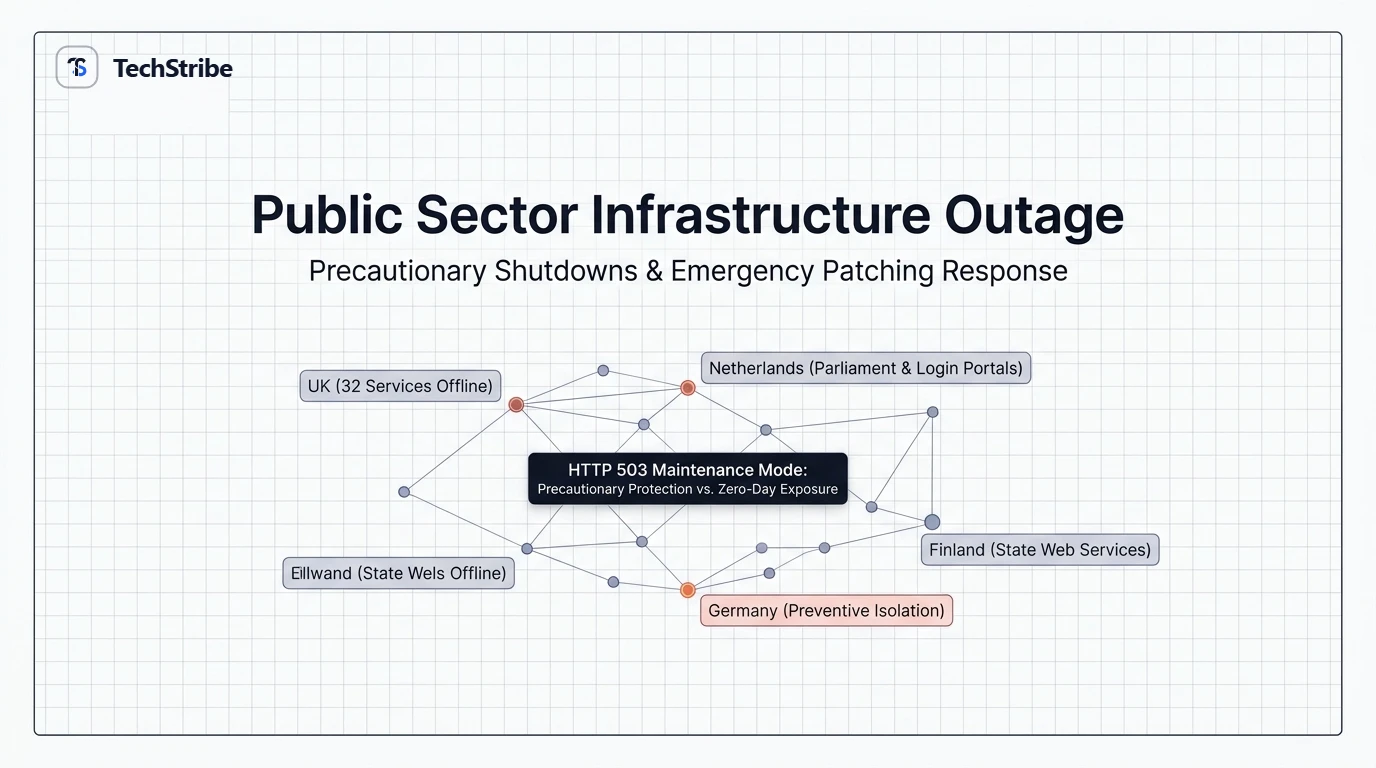
| United Kingdom | 32 government services and regional councils confirmed temporary outages, including portions of the Office for Budget Responsibility. |
| Netherlands | The national parliament, data protection authority, and DigiD municipal login integrations serving over 100 councils were isolated. |
| Finland | State IT agency Valtori temporarily withdrew public-facing web platforms and the National Land Survey for preventative patching. |
| Germany | Federal portals and municipal services in Mainz and Munich were placed into preventive maintenance mode. |
| France | Regional prefecture portals handling public citizen appointments and documents were taken offline pending package validation. |
| Australia | Australian Cyber Security Centre public endpoints and selected New South Wales departments initiated staged downtime. |
| Nepal | Thousands of government and national banking websites sharing a centralized government data center were taken offline simultaneously for collective remediation. |
The Triage Matrix: Patch, Isolate, or Pull Offline?
| Defensive Option | Best Suited For | Operational Trade-off |
|---|---|---|
| Immediate In-Place Patching | Modern environments with automated CI/CD and direct vendor package access. | Requires immediate worker restarts and risks application crashes if legacy modules break. |
| Network Isolation (WAF / VPN) | Internal management portals, intranet backends, and administrative tools. | Reduces external exposure but does not eliminate internal lateral movement risks. |
| Complete Outage (HTTP 503) | High-value public systems where PHP versions are uncertain or end-of-life. | Zero security exposure, but halts citizen services and creates temporary user disruption. |
Will Planned Security Downtime Hurt SEO?
If your organization ever needs to take a production website offline for urgent vulnerability mitigation, the technical HTTP implementation determines whether search rankings survive:
- Return HTTP 503 (Service Unavailable): Never return a 200 OK blank page, a 404 Not Found, or an ambiguous 500 error. An explicit 503 status code tells Googlebot and search crawlers that the outage is intentional and temporary.
- Include a Retry-After Header: Send a header such as
Retry-After: 3600(1 hour) orRetry-After: 86400(24 hours). Crawlers will respect this interval and return later without dropping indexed URLs. - Never Mass-Redirect to the Homepage: Do not redirect all site URLs to a temporary maintenance URL via 302 or 301 redirects. Search engines can misinterpret this as soft-404 behavior and de-index interior pages.
- Monitor Search Console After Recovery: Once servers are patched and restored, check the Crawl Stats report in Google Search Console to verify response codes have returned to clean 200 OK statuses.
8 Lessons for Engineering & Infrastructure Teams
- Maintain a Living Software Bill of Materials (SBOM): Know every server, container, virtual machine, and appliance executing PHP across your entire organization.
- Enforce Supported Runtime Lifecycles: Upgrading PHP across active versions takes minutes; upgrading from abandoned PHP 7.x during an active crisis takes days.
- Establish Clear Downtime Authorization Protocols: Define who has the authority to pull public systems offline during zero-day outbreaks without bureaucratic friction.
- Regularly Rehearse Backup Restorations: Backups are only valid if disaster recovery procedures have been tested under timed drills.
- Deploy Pre-configured Static Maintenance Pages: Have a lightweight, CDN-hosted static maintenance page ready to trigger with valid 503 headers instantly.
- Do Not Treat WAFs as Final Fixes: Web Application Firewall rules buy valuable hours, but attackers routinely discover bypass techniques against regex filters.
- Minimize Public Attack Surfaces: Disable unnecessary extensions, public endpoints, and unused file upload modules across production servers.
- Maintain Transparent Public Incident Communication: Proactive, honest status page updates preserve user trust during defensive outages.
Frequently Asked Questions
Were government websites actually hacked during PHP2Shell?
The vast majority of documented government outages were proactive, defensive shutdowns to prevent intrusion while patches were applied, rather than active server compromises.
Which countries confirmed taking services offline?
Documented reports confirmed temporary shutdowns in the United Kingdom, Netherlands, Germany, Finland, France, Belgium, Austria, the Czech Republic, Australia, and Nepal.
Why couldn’t governments just patch their systems while keeping them online?
Exploit details leaked before pre-compiled enterprise OS packages were available. Furthermore, applying core PHP fixes requires restarting web workers, which causes brief service interruptions regardless.
Did United States federal agency websites go offline?
Major US federal websites remained online, with CISA and the NSA urging emergency mitigation, active monitoring, and immediate patch deployment.
Does taking a commercial website offline hurt search engine rankings?
A brief outage (under 48 hours) configured with an HTTP 503 Service Unavailable header and a Retry-After directive has virtually no negative impact on Google rankings.
How can private site owners avoid needing emergency shutdowns?
Keep PHP updated to actively supported branches (PHP 8.3 or 8.4), maintain automated staging environments, and subscribe to official security advisories to patch immediately upon release.