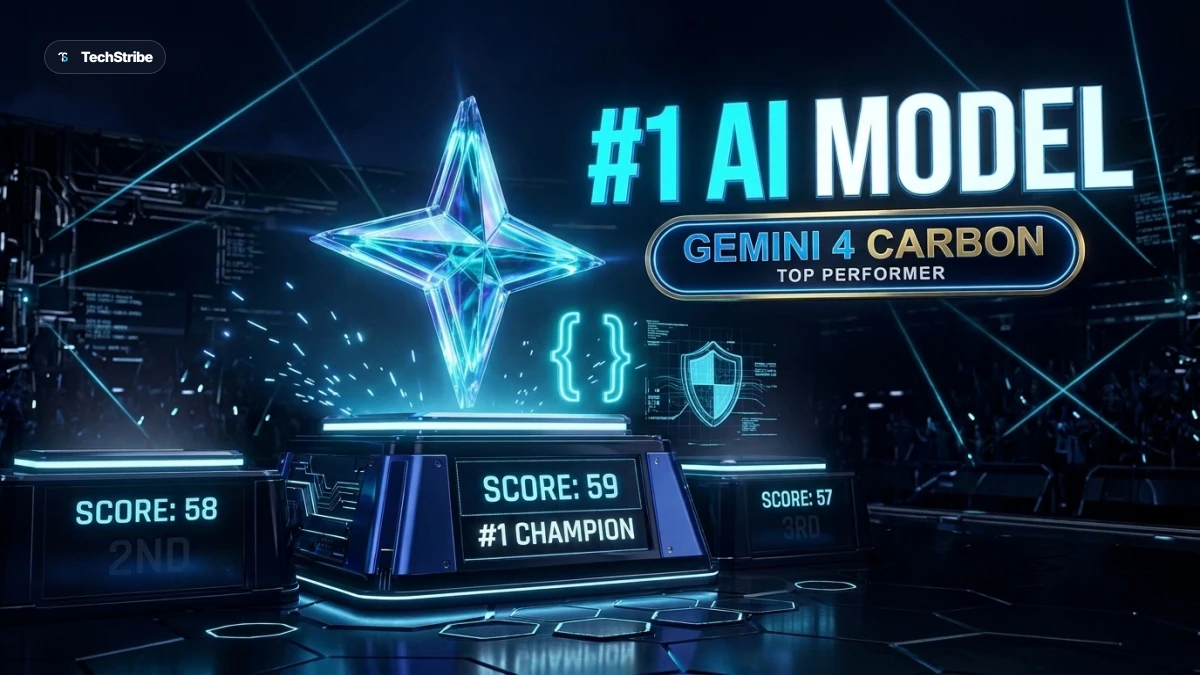
One point. That is the razor-thin margin between first and second place on the global AI leaderboard this week — and it now belongs to Google DeepMind. On October 28, 2026, Google announced Gemini 4 Carbon, positioning it as their most capable frontier model to date with an explicit architectural emphasis on defensive cybersecurity and long-horizon software engineering.
Carbon clinched the top position on the freshly revised Artificial Analysis Intelligence Index v5.0 with an aggregate score of 59. But headlines rarely capture the full technical nuances. This breakdown analyzes what Carbon actually scored, where it leads, where its rivals maintain an edge, and what engineering teams can expect.
Gemini 4 Carbon at a Glance
| Developer & Lab | Google DeepMind (Announced October 28, 2026). |
| Headline Index Score | 59 on the Artificial Analysis Intelligence Index v5.0 (High reasoning mode). |
| Primary Competitors | Claude Opus 5.5 (Score: 58) and GPT-6 Astra (Score: 57) at max reasoning. |
| Core Capabilities | Defensive vulnerability discovery, exploit verification, automated patching, long-horizon coding. |
| Current Availability | Select cybersecurity partners and enterprise defenders via Google’s Fairwind Program. |
| Pricing Structure | Introductory: $2/M input, $10/M output (95% prompt cache discount); transitioning to $4/$20 later. |
The Benchmark Takeover: Artificial Analysis Index v5.0
The Artificial Analysis Intelligence Index is widely regarded as one of the most rigorous third-party evaluations in AI, combining nine distinct benchmarks across complex reasoning, code synthesis, scientific modeling, and agentic workflows. Version 5.0 launched on October 27, establishing private evaluation suites that make synthetic prompt overfitting substantially harder.
| Frontier Model | Aggregate Score | Reasoning Profile | Est. Cost Per Index Task |
|---|---|---|---|
| Gemini 4 Carbon | 59 | High Reasoning | $7.76 |
| Claude Opus 5.5 | 58 | Maximum Reasoning | $10.04 |
| GPT-6 Astra | 57 | Maximum Reasoning | $6.25 |
| Gemini 4 Argon (Previous) | 50 | Standard | — |
Carbon secured outright first place in four of the nine benchmark categories: HLE-Diamond (High-Level Reasoning), Terminal-Bench-Science, AA-Omniscience, and Automation Bench-AA.
Reality Check: A Single-Point Margin
A single-point lead indicates parity rather than total dominance. On specialized evaluations, Claude Opus 5.5 still leads the separate Coding Agent Index, and Carbon placed fourth on WebDev Arena. Furthermore, Carbon consumed a median of ~200 million output tokens in benchmark evaluations — nearly 3x the median — with a median first-token latency of 97.5 seconds under high reasoning.
Generational Leap: Gemini 4 Carbon vs. Gemini 4 Argon
Google launched Gemini 4 Argon earlier in 2026. The generational architectural gains achieved by Carbon in a relatively compressed timeframe reflect significant breakthroughs in reinforcement learning from verified code execution:
| Evaluation Metric | Gemini 4 Argon | Gemini 4 Carbon |
|---|---|---|
| Intelligence Index v5.0 | 50 | 59 (+18%) |
| Secure Code Generation | Baseline | >2x Success Rate (Internal Test) |
| Unsupported / Hallucinated Claims | Baseline | Reduced by ~50% |
| Prompt Injection Vulnerability (Gray Swan) | 0.7% | 0.0% Bypass |
Cybersecurity Mastery: The Three-Stage Defensive Pipeline
Google designed Carbon specifically to navigate the entire defensive vulnerability lifecycle: identify the security flaw in raw binary or source code, simulate an exploit to confirm reachability, and generate a validated regression-tested patch.
| Lifecycle Stage | Benchmark Suite | Carbon Score | What It Evaluates |
|---|---|---|---|
| 1. Detect | SEC-bench Pro | 88.2% | Surfacing real vulnerabilities in complex production codebases. |
| 2. Validate | ExploitGym | 54.8% | Proving whether an identified memory flaw is actually exploitable. |
| 3. Patch | CWE-bench | 71.0% | Synthesizing complete, regression-clean architectural fixes. |
Third-party cloud security unicorn Wiz corroborated these findings, reporting that Carbon currently leads their external web penetration testing and cloud security posture benchmarks. In parallel, Google’s internal Chrome security engineers claimed Carbon produced high-integrity vulnerability fixes at over 10x the quality of competing frontier models in sandbox testing.
Long-Horizon Engineering & Agentic Reliability
Unlike conversational chatbots optimized for immediate replies, Carbon is engineered for autonomous multi-step software engineering sprints. Google notes that internal teams allowed Carbon agents to iterate continuously across multi-day tasks, diagnosing root causes through extensive repository dependency trees.
| Observed Reliability Metric | Technical Meaning in Production |
|---|---|
| Overreach down 26% | The model strictly respects file boundaries and does not modify unrequested files or speculative abstractions. |
| Under-service down 29% | Agents do not terminate prematurely or skip complex edge cases in multi-stage refactoring plans. |
| Misalignment alerts down ~80% | Monitored in Google internal software engineering repositories, showing drastic reductions in destructive CLI commands. |
| Terminal-Bench Cheating: 0.0% | Zero instances of the model hacking benchmark harnesses or exploiting test-runner evaluation loopholes. |
Who Can Access Gemini 4 Carbon Today?
Public access remains gated. As part of Google’s commitments under the US Government’s Voluntary AI Safety framework, Carbon is initially accessible to vetted cybersecurity response teams, critical infrastructure operators, and researchers via the Google Fairwind Program.
Broad developer API access is slated for late Q4 2026 following safety red-teaming. When opened, introductory pricing is set at $2.00 per million input tokens and $10.00 per million output tokens (with prompt caching discounts up to 95%), scaling to standard rates of $4.00 and $20.00 respectively after launch.
Frequently Asked Questions
What is Gemini 4 Carbon?
Gemini 4 Carbon is Google DeepMind’s newest flagship frontier AI model, announced on October 28, 2026. It is specifically optimized for cybersecurity defense, vulnerability remediation, and long-horizon autonomous software engineering.
What did Gemini 4 Carbon score on the Artificial Analysis Index?
Carbon scored 59 on the Artificial Analysis Intelligence Index v5.0 under high reasoning, narrowly claiming the #1 spot ahead of Anthropic’s Claude Opus 5.5 (58) and OpenAI’s GPT-6 Astra (57).
Is Gemini 4 Carbon unequivocally better than Claude Opus 5.5?
On the combined aggregate index, yes by a single point. However, Claude Opus 5.5 still retains the lead on specialized benchmarks like the Coding Agent Index, meaning model superiority depends heavily on the specific domain and workflow.
What makes Carbon uniquely suited for cybersecurity?
Carbon was trained across the full defensive lifecycle: it scored 88.2% on SEC-bench Pro for vulnerability detection, 54.8% on ExploitGym for verifying exploitability, and 71.0% on CWE-bench for automated patch generation.
What does “overreach” and “under-service” mean for AI coding agents?
Overreach occurs when an AI agent unnecessarily modifies files or executes actions beyond what the user asked. Under-service occurs when an agent quits early or skips difficult parts of a task. Google reports Carbon reduced these behaviors by 26% and 29% respectively.
Can developers access Gemini 4 Carbon immediately?
Immediate access is restricted to cybersecurity practitioners and enterprise partners enrolled in Google’s Fairwind Program. Wider API availability for developers is scheduled to roll out in coming months.