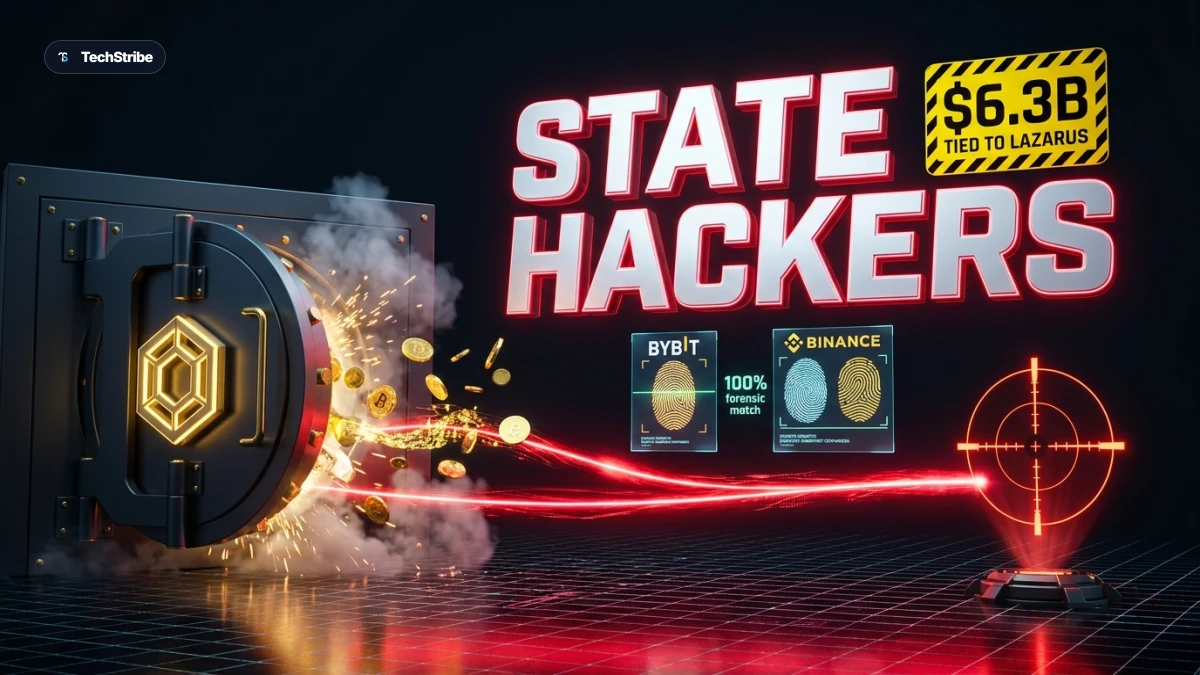
Most digital bank robbers seek an untraceable personal payout. But the perpetrators behind the largest cryptocurrency theft in human history may answer directly to a sovereign state. Within hours of the unprecedented $6.3 billion draining of Binance hot wallets, leading blockchain forensic analysts pointed to a single coordinated culprit: TraderTraitor, an elite cyberwarfare division operating under North Korea’s Reconnaissance General Bureau.
If validated by international law enforcement, the Binance breach was not merely an opportunistic hack. It represents an industrialized, state-sponsored cyber operation engineered to evade global financial sanctions and fund national weapons programs. Here is what the forensics reveal, how it mirrors the $1.5B Bybit heist, and what software teams must learn from the attack patterns.
The Attribution Assessment at a Glance
| Investigative Body | Confidence Level | Key Findings & Statements |
|---|---|---|
| TRM Labs | High Confidence | Attributes breach to TraderTraitor based on on-chain telemetry, Tornado Cash staging, and cross-chain execution signatures. |
| Chainalysis | Likely | CEO Jonathan Levin identified fund mixing with previous North Korean-attributed exploits, including Bitget and Bybit. |
| ZachXBT | Corroborated | Independent on-chain tracing identified consolidation of stolen Binance funds into intermediary clusters linked to Lazarus wallets. |
| Blockaid | Early View | Noted that contract deployment speed and staging sophistication closely mirror DPRK tradecraft. |
| Binance Inquiry | Neutral / Ongoing | Internal forensic investigation is active; Binance has not officially named a culprit. |
Who Is TraderTraitor?
TraderTraitor (also tracked by cybersecurity agencies under designations associated with the Lazarus Group) is an elite cyber-espionage and financial theft syndicate operating on behalf of the North Korean state. Unlike hacktivists who deface websites or ransomware cartels seeking extortion, TraderTraitor operates with military discipline, targeting financial institutions, bridges, and cryptocurrency exchanges.
The FBI formally attributed the $1.5 billion Bybit theft of February 2025 to TraderTraitor. Crucially, intelligence agencies highlight that TraderTraitor rarely breaches systems through raw cryptographic breakthroughs; instead, they target the human attack surface via sophisticated social engineering, tailored malware, and compromised developer endpoints.
Why Attribution Connects the Dots
Binance’s preliminary disclosure pointed directly to a compromised DevOps engineer’s laptop. Infiltrating developer workstations through targeted spear-phishing or disguised technical recruitment challenges is precisely the core signature modus operandi of North Korean cyber operatives.
Forensic Fingerprints: The Three Shared Signatures
Blockchain forensics specialists at TRM Labs identified three distinct structural parallels linking the Binance breach to prior state-backed heists:
- Tornado Cash Seeding: In both the Bybit and Binance incidents, the operator wallets used to deploy malicious delegation payloads and trigger sweeper contracts were funded with small, deliberate withdrawals from Tornado Cash to obscure source origins.
- Pre-Staged Multi-Chain Authorizations: The attackers did not generate signatures in real time during the heist. Cryptographic authorizations were quietly harvested days in advance and detonated in an automated, coordinated burst across ten blockchains in 20 minutes.
- Laundering Infrastructure Convergence: Chainalysis detected that stolen Binance funds were consolidated into known peeling chains that intersected with laundering addresses from the Bitget and KelpDAO compromises.
Side-by-Side: Binance, Bybit, and KelpDAO
| Incident | Total Loss | Infiltration Mechanism | Attribution |
|---|---|---|---|
| Bybit (Feb 2025) | $1.5 Billion | A Safe{Wallet} developer workstation compromised via social engineering, leading to malicious transaction injection. | FBI: TraderTraitor |
| KelpDAO (Apr 2026) | $292 Million | Compromised bridge validator key pair on LayerZero infrastructure. | TRM / Cyble: TraderTraitor |
| Binance (Oct 2026) | $6.36 Billion | Compromised DevOps laptop, lateral pivot to internal service container, and EIP-7702 sweeper automation. | TRM / Chainalysis: TraderTraitor |
Why Does a Sanctioned Nation Rob Crypto Exchanges?
Due to comprehensive UN and US financial sanctions, North Korea is almost entirely cut off from SWIFT, Western clearinghouses, and global correspondent banking. Illicit cryptocurrency acquisition provides a bypass mechanism to generate foreign currency reserves.
- Sovereign Revenue Dependency: A 2024 UN Security Council Panel of Experts report estimated that cyber activities generate roughly 50% of North Korea’s foreign currency income.
- Military & Nuclear Financing: An October 2025 assessment ratified by 11 allied nations concluded that stolen digital assets directly subsidize state-backed ballistic missile research and military procurement.
- Unprecedented Scale: The $6.36 billion Binance hack alone represents more than triple the total estimated cryptocurrency stolen by all North Korean hacking groups combined throughout 2025.
The Laundering Playbook: How Stolen Billions Move
Draining wallets is only step one; converting billions in blacklisted tokens into usable fiat before issuers freeze addresses is where state-sponsored laundering syndicates excel:
- Rapid Stablecoin Conversion: Chainalysis noted that the perpetrators rapidly converted $325 million in centralized stablecoins (USDT/USDC) into $285 million of native Ether (ETH) within 20 minutes, exploiting the reality that Ethereum cannot be frozen at the protocol level.
- Intermediate Stopover Wallets: Over $175 million was routed through thousands of ephemeral intermediary wallets, cycling tokens to fragment transaction graphs and confuse automated AML monitors.
- Over-the-Counter (OTC) Networks: Telemetry from CNBC interviews with TRM investigators reveals that proceeds are frequently offloaded through underground OTC brokers operating primarily across Southeast Asia and mainland China.
Developer Alert: How to Spot the Fake-Job Infiltration Trap
Federal cybersecurity advisories consistently warn that North Korean operators masquerade as recruiters targeting web3, devops, and security engineers. Engineering teams should train staff to identify these specific indicators:
Common Social Engineering Red Flags
- Unsolicited High-Paying Offers: Recruiters reaching out via Telegram or LinkedIn offering compensation 2x–3x above market rate.
- Executable Coding Tests: Interview tasks requiring candidates to download a GitHub ZIP, run an npm package, or execute a script locally to “debug a project.”
- Compressed Timelines: Extreme urgency pushing candidates to bypass corporate device security policies or run scripts on company-managed laptops.
- Phantom Organizations: Domain names registered within the last 30 days mimicking legitimate venture firms or web3 protocols.
Frequently Asked Questions
Who is officially being blamed for the Binance hack?
Leading private blockchain analytics firms TRM Labs and Chainalysis attribute the attack with high confidence to North Korea’s TraderTraitor unit. However, government agencies and Binance itself have not formally finalized an official attribution.
What is TraderTraitor?
TraderTraitor is a specialized state-sponsored hacking division linked to North Korea’s Lazarus Group. It focuses exclusively on cryptocurrency theft and has been previously tied by the FBI to the $1.5 billion Bybit breach.
Why does North Korea target cryptocurrency exchanges?
Severe international sanctions block North Korea from traditional global banking channels. Stolen cryptocurrency provides an essential source of hard foreign currency to finance government operations and state programs.
How is the Binance hack similar to the Bybit heist?
Both attacks avoided cryptographic flaws and instead targeted the administrative layer: Bybit via a developer workstation social engineering trap, and Binance via a compromised DevOps laptop and lateral container pivot.
Does North Korean attribution change who covers user losses?
No. Binance CEO Richard Teng has publicly reaffirmed that all affected user funds will be reimbursed in full via Binance’s emergency SAFU reserve and company treasury assets.
Can state-stolen crypto funds ever be recovered?
Partially. Rapid collaboration with centralized stablecoin issuers (Tether and Circle) successfully froze roughly $3 billion in USDT and USDC within hours, but native assets like Bitcoin and Ethereum remain substantially harder to reclaim once dispersed.