Imagine your hosting company emails you: “Emergency maintenance. Your site may be briefly unavailable.” You did nothing wrong. Your site worked fine last night. The problem is not in your theme, your plugins, or your code. It is in PHP itself, the engine underneath millions of websites.
In October 2026, security researchers and the official PHP development team disclosed two critical zero-day vulnerabilities, nicknamed PHP2Shell. Here is what they mean for website owners, developers, and businesses in plain English, and the exact steps you should take today.
The Quick Answer
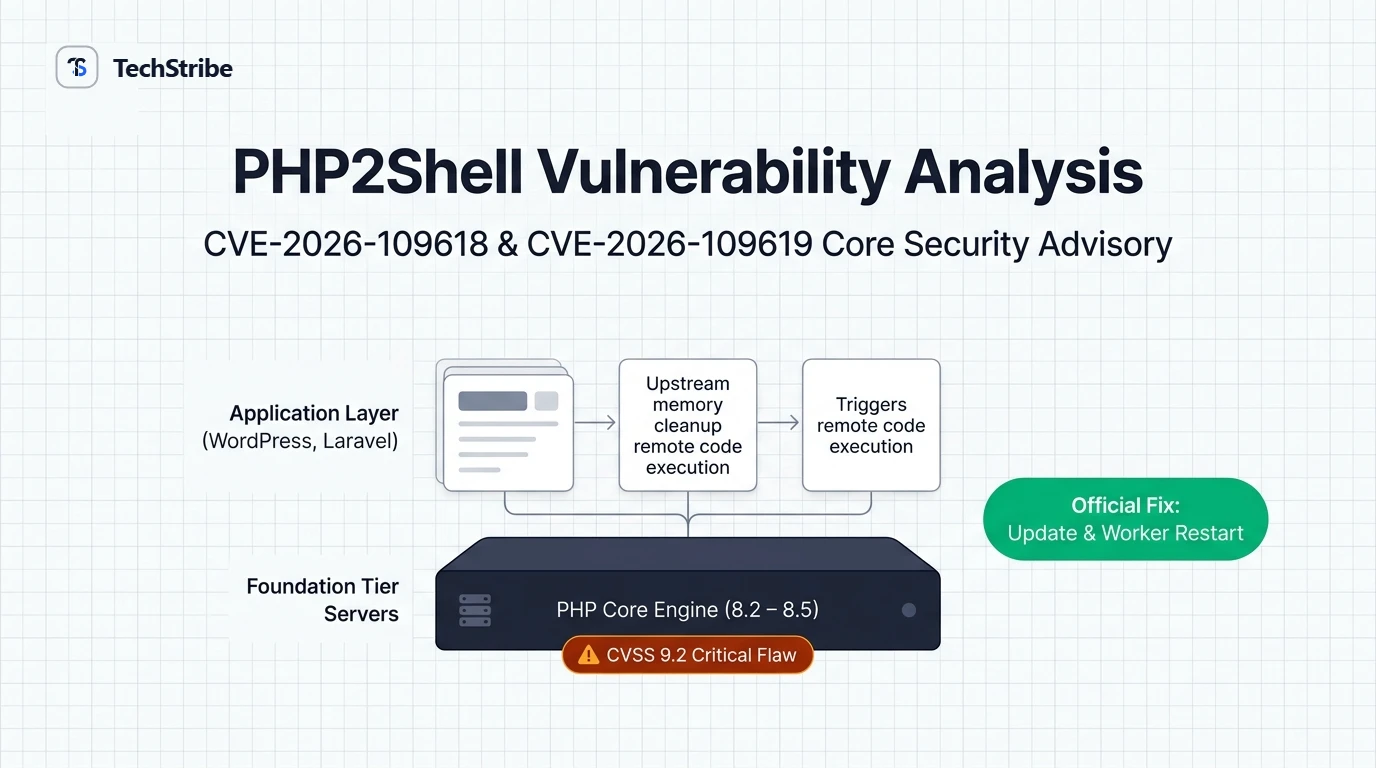
PHP2Shell in one paragraph: PHP2Shell is the collective nickname for two critical core PHP vulnerabilities, CVE-2026-109618 and CVE-2026-109619. Both are rated 9.2 out of 10 by PHP under the CVSS v4.0 scoring standard, allowing an unauthenticated remote attacker to execute arbitrary commands on a web server without logging in. Official patches were released on October 21, 2026. Updating PHP and restarting your web server workers is the only complete fix.
Do This Today: A 6-Step Checklist
- Find your PHP version: Check your hosting control panel (cPanel, hPanel, Plesk), open WordPress Site Health under Tools → Site Health → Info, or ask your host.
- Ask your host what they have done: Managed cloud and shared hosts frequently patch upstream packages, but request confirmation in writing that fixed builds are running.
- Update to a fixed release: Verify your server is on PHP 8.5.12, 8.4.27, 8.3.36, or 8.2.35.
- Restart PHP after updating: Running workers (PHP-FPM, Apache mod_php, or LiteSpeed) retain vulnerable code in active memory until workers are recycled.
- Apply temporary mitigations if you cannot update immediately: Disable
session.upload_progress.enabledin yourphp.inito shut down confirmed exploit paths. - Audit your server: Scan logs for unusual outbound connections, unknown admin accounts, unexpected file writes in
/tmpor upload directories, and traffic spikes.
What PHP2Shell Actually Is
PHP is the server-side scripting language that powers more than 70% of the web, including WordPress, Laravel, Drupal, and custom web applications. These vulnerabilities reside inside PHP’s native memory management layer, not in application-level user code.
- Unauthenticated: The attacker does not need an account, admin credentials, or active session tokens.
- Remote Code Execution (RCE): The vulnerability permits attackers to inject and run system-level shell commands on the server remotely.
- The Nickname: Security researchers dubbed it “PHP2Shell” because successful exploitation grants attackers an interactive command shell on the host.
The Two Vulnerabilities Explained
| CVE Identifier | In Plain English | Severity (CVSS v4.0) |
|---|---|---|
| CVE-2026-109618 | When PHP encounters an out-of-memory condition during request parsing, it leaves internal data structures partially uninitialized. During cleanup, mishandled pointers create an arbitrary code execution pathway. | 9.2 Critical |
| CVE-2026-109619 | A use-after-free condition where PHP retains references to request parameters after memory has been freed. A subsequent request handled by the same persistent worker process can access stale references, leaking worker memory or executing injected shellcode. | 9.2 Critical |
Timeline of the Disclosure
| Date (2026) | Milestone & Impact |
|---|---|
| August 2026 | The underlying flaws were reportedly discovered during automated memory fuzzing assisted by AI analysis tools. |
| October 20 | The PHP team announced an emergency out-of-band security release. Technical details and proof-of-concept indicators leaked publicly ahead of schedule. |
| October 21 | Official PHP security releases were published across branches 8.2, 8.3, 8.4, and 8.5. National cybersecurity agencies issued urgent patching bulletins. |
| October 22–Present | Threat intelligence firms report widespread automated scanning, mass weaponization attempts, and confirmed exploits in the wild. |
Who Is at Risk?
| Server Architecture | Risk Level | Exposure Notes |
|---|---|---|
| Apache with mod_php | Highest Priority | Demonstrated exploits trigger before application-level middleware or sanitization code executes. |
| PHP-FPM (Nginx / Apache) | Urgent | Standard production stack. Certain vector paths require specific configurations, but exploitability has been verified. |
| LiteSpeed & FrankenPHP | At Risk | Both web servers bundle or embed PHP runtimes and require vendor-level binary updates. |
| WordPress, Laravel, Drupal | Depends on Engine | Application security cannot prevent engine-level memory flaws. If PHP underneath is unpatched, the site is vulnerable. |
Fixed Official Versions
| PHP Branch | Fixed Version | Status & Action Required |
|---|---|---|
| PHP 8.5 | 8.5.12 | Current stable release. Update via package manager. |
| PHP 8.4 | 8.4.27 | Supported branch. Apply maintenance update. |
| PHP 8.3 | 8.3.36 | Supported branch. Apply maintenance update. |
| PHP 8.2 | 8.2.35 | Security-only branch. Update immediately. |
| PHP 8.1, 8.0 & 7.4 | End-of-Life (EOL) | No upstream official fix. Must rely on enterprise Linux distribution backports (RHEL, Ubuntu ESM) or upgrade branches immediately. |
Emergency Mitigations (If You Cannot Update Today)
Updating PHP is the only complete resolution. However, if your environment requires staging approval or software compatibility testing, apply these server-level mitigations to restrict the attack surface:
| Configuration Directive | Recommended Value | Defensive Mechanism |
|---|---|---|
| session.upload_progress.enabled | Off | Blocks the primary confirmed vector that weaponizes session file manipulation during multipart uploads. |
| fatal_error_backtraces | Off (PHP 8.5) | Prevents memory address disclosure during forced worker crashes. |
| post_max_size / upload_max_filesize | Enforce strict limits | Restricts large payloads designed to trigger out-of-memory heap conditions. |
Frequently Asked Questions
What is PHP2Shell?
PHP2Shell is the collective name for two critical PHP core vulnerabilities (CVE-2026-109618 and CVE-2026-109619) that allow unauthenticated remote attackers to execute arbitrary code on web servers without providing credentials.
Which PHP versions fix PHP2Shell?
The official patched releases are PHP 8.5.12, 8.4.27, 8.3.36, and 8.2.35. All prior versions on these branches are vulnerable.
Is my WordPress site vulnerable to PHP2Shell?
WordPress itself does not cause the flaw, but if your web hosting server runs an unpatched version of PHP underneath, your WordPress site and database are fully exposed to exploitation.
Is PHP2Shell actively being exploited in the wild?
Yes. Major cybersecurity threat intelligence firms, including Arctic Wolf, Qualys, and BleepingComputer, have reported mass internet-wide scanning and active exploitation attempts since disclosure.
How can I verify which PHP version my server is running?
In WordPress, navigate to Tools > Site Health > Info > Server. Alternatively, log into your hosting control panel or run php -v via SSH on your server command line.
Does updating PHP automatically protect my site?
You must restart your web server and PHP workers (such as PHP-FPM or Apache) after updating packages. Running worker processes will continue executing vulnerable binaries in memory until restarted.
What should I do if my server runs PHP 7.4 or 8.1?
PHP 7.4 and 8.1 are officially end-of-life and will not receive upstream security releases. You must upgrade to a supported branch (8.2+) or obtain commercial vendor backported builds through LTS Linux distributions.