Imagine you need to sign a single complex legal contract. You hire one brilliant legal scholar who reads every sentence with microscopic care, weighing clauses and decisions step by step. Now imagine you need to stamp ten thousand shipping envelopes. You do not want that single scholar; you want an army of a thousand helpers, all stamping identical envelopes in unison.
Modern computers face both kinds of computational work every millisecond. The CPU is engineered for the complex legal contract; the GPU is engineered for the ten thousand envelopes. Understanding this division of labor explains why your computer opens applications instantly, why 3D games demand high-power graphics cards, and why modern artificial intelligence relies entirely on GPU clusters.
The Quick Answer
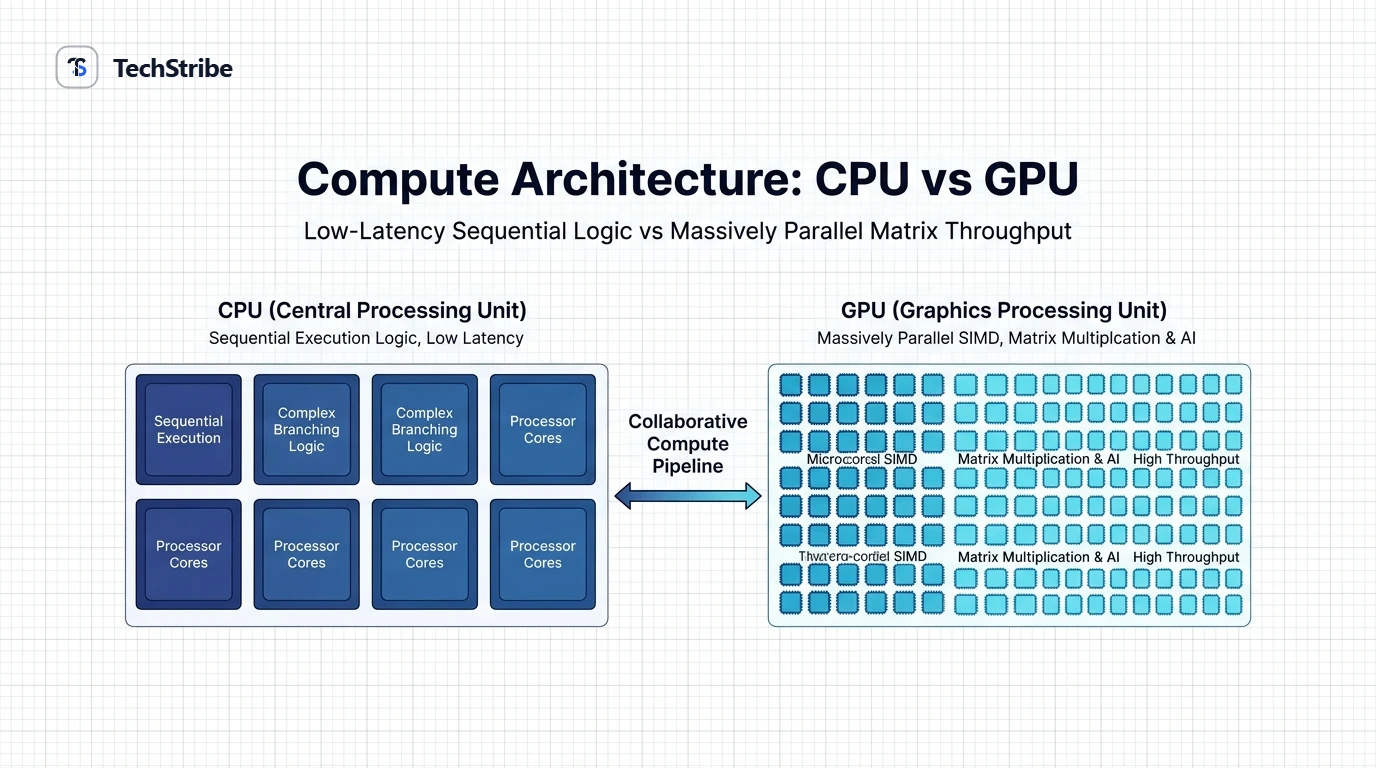
The core difference in one line: A CPU (Central Processing Unit) consists of a few highly powerful processor cores optimized for low-latency, sequential logic and complex branching calculations. A GPU (Graphics Processing Unit) consists of thousands of smaller, simpler cores optimized for massively parallel throughput and repetitive mathematical operations (like rendering graphics pixels or multiplying AI neural matrices).
Architectural Comparison: CPU vs. GPU
| Architectural Feature | CPU (Central Processing Unit) | GPU (Graphics Processing Unit) |
|---|---|---|
| Core Count | Few (typically 8 to 24 powerful cores). | Massive (typically 2,000 to 16,000+ micro-cores). |
| Optimization Focus | Low Latency | High Throughput |
| Execution Model | Sequential instructions with complex “if/then” branching. | Massively parallel SIMD (Single Instruction, Multiple Data). |
| Memory Architecture | Large L1/L2/L3 cache hierarchies connected to system RAM. | Dedicated high-bandwidth VRAM (GDDR6, GDDR7, or HBM3/HBM4). |
| Primary Responsibilities | Booting the operating system, running business logic, and scheduling system tasks. | 3D geometry calculations, rasterization, video encoding, and AI matrix multiplication. |
The 7 Key Differences Explained
- Core Architecture: CPU cores are large, complex silicon engines featuring advanced branch predictors, out-of-order execution logic, and speculative calculation units. GPU cores are stripped down to fundamental arithmetic logic units (ALUs) built to repeat basic math.
- Latency vs. Throughput: A CPU is designed to finish one complex task as fast as humanly possible. A GPU is designed to process tens of thousands of simultaneous calculations per second, even if individual items take a few microseconds longer.
- Branching vs. Repetition: CPUs handle complex conditional statements (“if user clicks X, calculate Y, else abort Z”) effortlessly. GPUs experience severe performance degradation if parallel cores take diverging execution branches.
- Memory Bandwidth: High-end desktop CPUs communicate with DDR5 RAM at roughly 60 to 90 GB/s. High-end GPUs communicate with their internal VRAM at 1,000 to 1,800 GB/s.
- Software Frameworks: CPUs execute standard x86 and ARM assembly instructions natively. GPUs require specialized parallel computing platforms such as NVIDIA CUDA, Apple Metal, or OpenCL to harness their cores.
- Hardware Acceleration: Modern GPUs incorporate dedicated matrix tensor cores (NVIDIA Tensor Cores) and ray tracing hardware units specifically built for AI and 3D lighting.
- Power and Cooling: GPUs consume high power under sustained load (often 250W to 575W TDP on enthusiast cards) and require dedicated cooling solutions.
Everyday Tasks: Who Does What?
| Task | Primary Processor | Why It Fits That Architecture |
|---|---|---|
| Running Operating System & Office Apps | CPU | Driven by user interactions, logic conditionals, and unpredictable inputs. |
| Compiling Source Code | CPU | Parsing syntax trees and resolving dependencies requires sequential reasoning. |
| Playing Modern 3D Games | GPU | Rendering millions of polygons, shaders, and pixels 120 times per second in parallel. |
| Training & Running Local AI Models | GPU | Neural networks are essentially giant matrix multiplication grids; GPUs compute billions of weights in parallel. |
Why AI Loves GPUs
Modern Large Language Models (LLMs) and transformer neural networks operate through billions of floating-point matrix multiplications. When a model predicts the next token in a sentence, it passes input vectors through layers of interconnected weights:
- Matrix Parallelism: Multiplying a 4,096-dimension vector against an attention weight matrix can be divided into thousands of independent math operations executed simultaneously across GPU cores.
- Dedicated Tensor Cores: Modern architectures include specialized hardware blocks engineered exclusively to perform 4×4 and 8×8 matrix multiplications in single clock cycles using reduced precision formats (FP16, BF16, FP8, INT4).
- Memory Bandwidth Saturation: Token generation speed is directly constrained by how quickly weights can be streamed from memory into computational cores. A GPU with 1,792 GB/s bandwidth outputs tokens up to 20x faster than a CPU limited to 80 GB/s.
Frequently Asked Questions
Can a GPU completely replace a CPU?
No. A computer cannot boot, manage memory, or execute an operating system without a CPU. The CPU serves as the central orchestrator that manages workloads and delegates parallel mathematical tasks to the GPU.
What is an Integrated GPU (iGPU)?
An integrated GPU is a graphics processing circuit built directly onto the same silicon die as the CPU. It shares the system’s main RAM rather than having its own dedicated VRAM, making it power-efficient and cost-effective for everyday computing.
Can CPUs run AI models?
Yes. Modern CPUs with AVX-512 and AMX instructions can run small quantized models (like 3B–7B parameters), but inference speeds will typically be 5x to 15x slower than dedicated graphics hardware.
What are NPUs and TPUs?
NPUs (Neural Processing Units) are low-power accelerators built into laptops for background AI tasks (like webcam effects and audio filtering). TPUs (Tensor Processing Units) are custom ASICs developed by Google specifically for data center machine learning.