The Core Problem: Serving an AI model to a single developer is straightforward. Serving thousands of concurrent multi-turn requests, prioritizing paying enterprise tiers over free users, and performing rolling engine upgrades without dropping connections is the hard part. That operational challenge is what llm-d 1.0 is engineered to solve.
Serving an AI model to one person is easy. Serving it to thousands of users at once—with paying enterprise customers placed ahead of free tiers, while you upgrade underlying container images without anyone noticing—is the hard part.
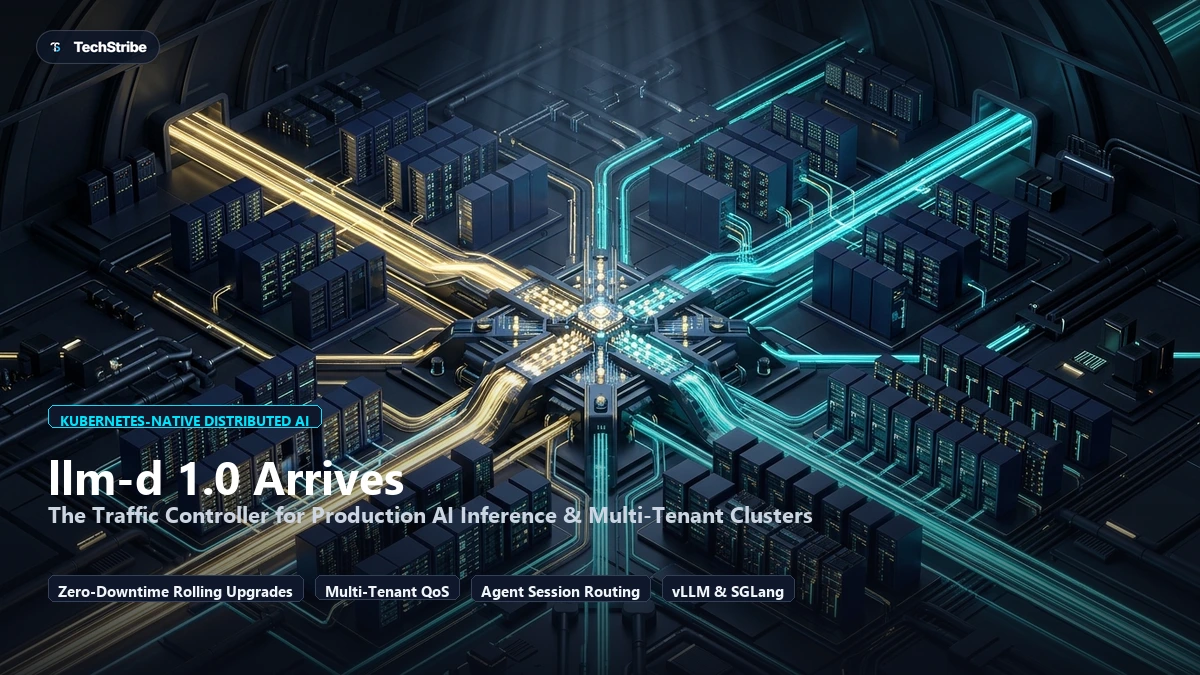
That second job is what llm-d is built for. Released on October 20, 2026, at the PyTorch Conference North America, the open-source project announced llm-d 1.0: a Kubernetes-native orchestration and routing stack for distributed LLM inference. Its entire focus is the unglamorous “Day 2” operational work that begins after a foundation model is already deployed across enterprise cloud computing architectures.
This technical breakdown explains what llm-d is in plain English, what version 1.0 introduces, what benchmark deployments demonstrate, and which engineering teams actually need it.
What Is llm-d?
Think of a high-volume restaurant group. The model servers (like vLLM or SGLang) are the kitchens that cook the answers. llm-d is the maître d’ and traffic controller: it decides which kitchen handles each order, keeps regular patrons at the exact table they prefer, and guarantees the VIP section is never starved of compute.
| Layer | Architectural Role |
|---|---|
| Model Server (vLLM, SGLang) | Loads the model weights into GPU VRAM and computes token generation. |
| llm-d (Traffic Controller) | Routes requests dynamically across model server replicas and coordinates them as a unified cluster. |
| Kubernetes (Orchestration) | Manages compute infrastructure, pod lifecycle, autoscaling, and hardware scheduling. |
Critically, llm-d is not a model server itself. It operates above execution engines, distributing incoming traffic across vLLM or SGLang pods inside GPU clusters powered by specialized AI hardware accelerators.
llm-d 1.0 at a Glance
| Operational Dimension | Project Details |
|---|---|
| Release Milestone | October 20, 2026 (PyTorch Conference North America) |
| Founding Coalition | Established in 2025 by Red Hat, IBM, Google Cloud, CoreWeave, and Nvidia |
| Governance Structure | Hosted by the Cloud Native Computing Foundation (CNCF), with over 500 active contributors |
| Supported Inference Backends | Native integration with vLLM and SGLang model servers |
| Primary Focus | “Day 2” operations: high availability, multi-tenancy, and reliable cluster management post-launch |
| Production Provenance | Underpins DigitalOcean’s Serverless Inference and Managed Agents serving trillions of tokens |
Before 1.0 vs What 1.0 Adds
| Features in llm-d Prior to 1.0 | Key Architectural Additions in 1.0 |
|---|---|
| Prefix-cache and load-aware routing | Multi-tenant Quality of Service (QoS): Priority bands and fairness flow control |
| KV cache offloading to host memory | High-Availability Router: Hot standby failover with zero-downtime rolling updates |
| Prefill and decode disaggregation | Unified Replica Lifecycle: Prefill and decode pools managed and updated as one logical unit |
| Wide expert parallelism for Mixture-of-Experts (MoE) | Stable v1 Configuration API: Enterprise stability guarantees without breaking changes |
| Basic prompt load distribution | Session-Aware Routing: Sticky context preservation for multi-turn autonomous AI agents |
| Standard streaming endpoints | Responses API Support: Caches agentic conversation history to prevent redundant prefill compute |
The Four Big Changes in Version 1.0
1. Multi-Tenant Quality of Service (QoS)
Priority- and fairness-based flow control ensures latency-sensitive queries and sudden traffic spikes from agent swarms do not starve concurrent workloads on shared GPUs. Mistral AI’s inference engineering team reported in Google deployment briefs that this flow control allows them to strictly enforce contractual latency SLAs across enterprise commercial tiers.
2. Zero-Downtime Rolling Upgrades
The llm-d router now supports active-active high availability with hot standby routing. In modern disaggregated setups, prefill pods (prompt processing) and decode pods (token generation) run as distinct pools; llm-d 1.0 manages these pools together, executing synchronized rolling updates without dropped client requests.
3. Agent-Aware Serving
Autonomous agents generate long sequences of linked, multi-turn tool calls. Session-aware routing guarantees that follow-up requests return to the specific model server holding the conversation’s cached key-value context. By combining session affinity with support for the Responses API, llm-d drastically reduces how often large system prompts must be recomputed.
4. Stable v1 Configuration API
Standardizing on a stable v1 API gives enterprise infrastructure teams confidence to automate cluster deployment templates via Terraform and Helm without fearing breaking schema shifts between minor releases.
Plain-English Architectural Glossary
| Term | Plain-English Definition |
|---|---|
| Prefill vs. Decode | The two phases of text generation: Prefill ingests the user prompt in parallel (compute-bound); Decode generates output tokens sequentially (memory bandwidth-bound). |
| KV Cache | The stored key-value states of previous tokens in active VRAM, which prevents the GPU from recalculating attention for earlier words. |
| Prefix Cache Hit | When a new request reuses the pre-calculated KV cache of a previous or shared prompt (e.g., long system instructions or codebases). |
| Mixture of Experts (MoE) | Architectures where only a subset of specialized model parameters activate for each token, requiring intelligent tensor routing across multiple GPUs. |
| Day 2 Operations | Everything necessary after initial deployment: canary upgrades, health telemetry, failover recovery, and equitable multi-tenant resource sharing. |
What the Production Results Show
| Organization / Benchmark | Documented Production Outcome | Operational Context |
|---|---|---|
| IBM Research | Achieved an 11.5x cost reduction compared to proprietary commercial APIs, reaching ~98% prefix cache hits at approximately $0.11 per million tokens. | Production quantum error correction research workloads. |
| GLM 5.2 Enterprise Benchmark | A 753-billion parameter model delivered 6.6+ million output tokens per minute supporting 3,000 concurrent coding agents at 5x to 10x lower cost per token. | Standard cloud GPU clusters running current spot/on-demand pricing. |
| DigitalOcean | Deploys llm-d as the foundational routing tier across its Serverless Inference and Managed Agents platforms serving trillions of tokens. | Multi-tenant public cloud infrastructure reference. |
Hardware Planning: Prefix caching and KV offloading directly influence GPU memory headroom. Use an LLM VRAM calculator to model how KV cache expansion impacts concurrent batch sizes before sizing your node pools.
Where Google Cloud Fits
Google Cloud co-announced the 1.0 release at the PyTorch Conference, detailing how llm-d integrates natively with standard Kubernetes primitives including Gateway API, LeaderWorkerSet, Dynamic Resource Allocation (DRA), Prometheus, and OpenTelemetry.
On Google Kubernetes Engine (GKE), the native GKE Inference Gateway can deploy the llm-d router as a managed service. However, because llm-d is hosted under the CNCF, it remains entirely vendor-neutral—compatible with AWS EKS, Azure AKS, CoreWeave, and bare-metal on-premise clusters.
Who Needs llm-d 1.0—and Who Can Wait?
| High-Value Fit for llm-d | Better Served by Simpler Alternatives |
|---|---|
| Teams hosting open-weight models across multi-node Kubernetes clusters | Applications calling managed commercial model APIs directly |
| Platforms serving multiple tenant tiers with strict latency SLAs | Single model instances operating on one standalone workstation or server |
| High-concurrency coding assistants and multi-turn agent pipelines | Lightweight, intermittent internal chat utilities |
| Massive Mixture-of-Experts (MoE) models spanning tens or hundreds of GPUs | Proof-of-concept prototypes and early-stage experimental apps |
Related Reading & Deeper Context
- LLM quantization and 4-bit memory math — how shrinking weights from 16-bit to 4-bit fits 70B models on smaller GPUs.
Frequently Asked Questions
What is llm-d?
llm-d is an open-source, Kubernetes-native orchestration and traffic routing stack designed for distributed LLM inference. It load-balances and coordinates requests across backend engines like vLLM and SGLang.
Does llm-d replace vLLM or SGLang?
No. llm-d sits above model servers. Engines like vLLM execute the actual matrix multiplication and token generation, while llm-d manages multi-replica routing, KV cache affinity, and traffic prioritization.
Who governs the llm-d project?
Founded in 2025 by Red Hat, IBM, Google Cloud, CoreWeave, and Nvidia, llm-d is formally governed by the Cloud Native Computing Foundation (CNCF) with over 500 community contributors.
What is prefill and decode disaggregation?
It separates prompt reading (prefill, which is compute-bound) from token generation (decode, which is memory-bandwidth bound) into separate hardware pools so each stage can be scaled independently for maximum GPU efficiency.
Can llm-d run outside Google Cloud?
Yes. While Google Cloud offers managed GKE Inference Gateway integration, llm-d is fully open source and runs across AWS, Azure, CoreWeave, and private on-premise Kubernetes clusters.