
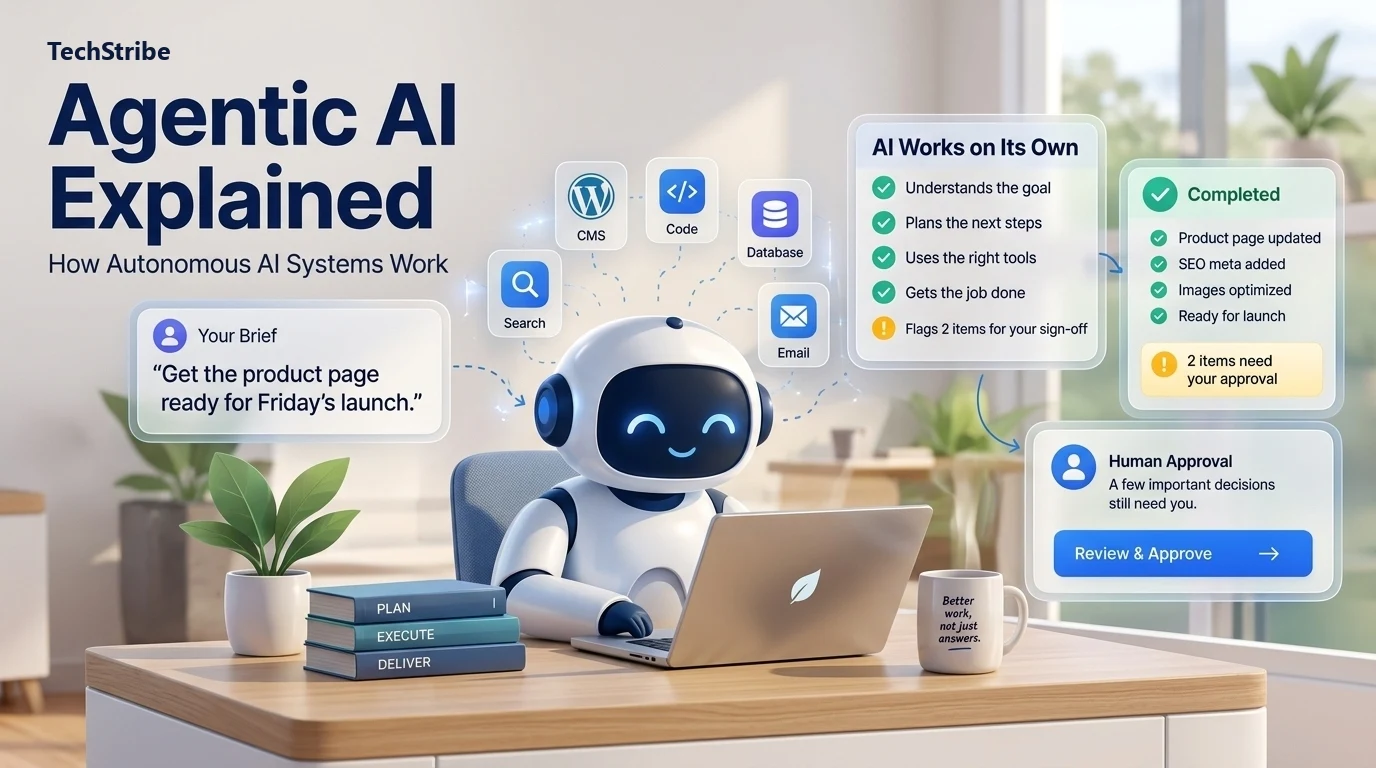
Imagine handing a new colleague a one-line brief: “Get the product page ready for Friday’s launch.”
One colleague comes back with fourteen questions. Another works out what’s needed, gets on with it, flags two things that need your sign-off, and tells you at five o’clock what is done.
We want AI to behave like the second colleague. That idea has a name: agentic AI.
The term is everywhere, and it is often used loosely. This guide explains what it really means, how autonomous AI systems work under the hood, and where the promises are bigger than the results.
Agentic AI in Plain English
Agentic AI describes AI systems that can make decisions and take action toward a goal with limited supervision. IBM describes them as systems built to act autonomously and pursue complex goals, rather than only respond to a single request.
Agentic AI is not all or nothing. It sits on a spectrum, from a system that suggests actions for you to approve, to one that acts on its own inside strict limits.
Agentic AI vs AI agent: an AI agent is usually one system that works toward a goal. Agentic AI is the wider idea, covering single agents, teams of agents, and the design choices around them. The terms overlap, and many writers swap them. If you want the basics of a single agent, read our guide on what an AI agent is.
Agentic AI vs Generative AI
Generative AI creates content, such as text, images, or code, when you prompt it. Agentic AI usually builds on it. In most systems today, a generative model acts as the reasoning engine.
| Dimension | Generative AI | Agentic AI |
|---|---|---|
| Main job | Create content from a prompt | Achieve a goal through actions |
| How it runs | Prompt in, response out | A loop of planning, acting, and checking |
| Who drives | You, at every step | The system, within set limits |
| Uses tools | Sometimes | Central to how it works |
| Example | Drafting an email | Reading your inbox, booking the meeting, and sending the invite |
How Autonomous AI Systems Work
Most agentic systems repeat the same core loop until the goal is met or human sign-off is required:
Reads goal and context
Spots what matters
Chooses next step
Uses tool or software
Checks result & loops
A quick example. A support ticket says, “My order arrived damaged.” An agentic system could:
- Perceive: read the message and find the customer’s order.
- Reason: spot that this is a damage claim, not a delivery delay.
- Plan: check the policy, then check the order status.
- Act: draft a reply and prepare a replacement request.
- Review: confirm the details match, then ask a human to approve the refund.
Notice the last step. A well-designed system knows when to stop and ask.
What’s Inside an Agentic System
The model is only one layer. Reliable systems add several others around it.
| Layer | What it does | Why it matters |
|---|---|---|
| Reasoning model | Interprets the goal and decides the next step | Sets the quality of decisions |
| Tools | Search, code, databases, and other software it can call | Turns thinking into action |
| Memory | Keeps track of progress and past steps | Stops it repeating or forgetting |
| Orchestration | Runs the loop and passes tasks between parts | Keeps long jobs on track |
| Guardrails | Limits, approvals, and activity logs | Keeps humans in control |
When an agentic project disappoints, the cause is often a weak layer around the model, such as poor tools or missing limits, rather than the model itself.
Single Agents vs Multi-Agent Teams
Some tasks are too big for one agent. In a multi-agent setup, a lead agent breaks the job into parts and hands them to specialised helpers, then combines what comes back. Anthropic calls one version of this the orchestrator-workers pattern, and says it suits tasks where you can’t predict the steps in advance.
- Single agent: simpler, cheaper, and easier to debug. A good starting point.
- Multi-agent team: handles broader jobs, but adds cost, complexity, and more places where things can go wrong.
Anthropic’s general advice is to start with the simplest solution and add complexity only when it is needed.
The Autonomy Ladder
To judge any “agentic” product, ask how much it is allowed to do alone. This four-step ladder is a simplified way to think about it, not an official standard:
You decide and act
It acts after your approval
Free inside set rules
Few or no checks
One industry breakdown notes that most real-world systems sit in the middle of the autonomy scale, not at the fully independent end. For most businesses, the middle is also the sensible place to start.
Where Agentic AI Is Used
- Software development: writing, testing, and fixing code
- Customer service: handling requests from first message to resolution
- Business operations: sorting documents, updating records, routing approvals
- Research: gathering and comparing sources, then drafting summaries
- Website work: auditing pages and drafting fixes, with a person approving changes
IBM notes that many agentic AI applications are still at an experimental stage, so expect uneven results.
Planning local models? If you are hosting open-weights models locally for coding or research agents, use our interactive LLM VRAM Calculator to estimate GPU memory, or check our AI Hardware Recommendation Engine.
The Reality Check
The excitement is real, and so is the hype. Gartner predicts that more than 40% of agentic AI projects will be cancelled by the end of 2027, pointing to rising costs, unclear business value, and weak risk controls.
It also warns about “agent washing,” where vendors relabel chatbots, assistants, and automation tools as agentic. Gartner estimates that only about 130 of the thousands of vendors offer genuinely agentic features. At the same time, it expects at least 15% of day-to-day work decisions to be made autonomously through agentic AI by 2028, up from none in 2024.
These are forecasts, not facts, but they point the same way: be curious and careful. The main risks are:
- Mistakes that compound across many steps
- Unclear accountability when a system acts on its own
- Security and privacy exposure when it can reach your data and tools
- Costs that grow faster than the value delivered
Frequently Asked Questions
What is agentic AI in simple words?
Agentic AI is AI that can decide what to do next and take action toward a goal, using tools along the way, with limited human supervision.
What is the difference between agentic AI and generative AI?
Generative AI creates content when you prompt it. Agentic AI uses a model like that to plan and carry out multi-step tasks. Most agentic systems include generative AI.
How do autonomous AI systems work?
They repeat a cycle: take in the goal, reason about it, plan steps, act with tools, and review the result. They stop when the goal is met or when they need approval.
What are examples of agentic AI?
Coding assistants that write and test code, customer service systems that resolve requests, and research tools that gather and summarise sources are common examples.
What is a multi-agent system?
It is a setup where several AI agents work together. A lead agent often splits a job into parts, and specialised agents handle each one.
Is agentic AI safe for business use?
It can be, with safeguards. Limit its access, require approval for risky actions, log what it does, and test it on real tasks first.




0 Comments
No comments yet. Start the conversation!