OpenAI spends months and millions of dollars running thousands of high-end GPUs to create a new frontier model. Then, a student opens a laptop, types a question into a chat window, and receives a response in less than a second for fractions of a cent.
Those two scenarios represent the two fundamentally different stages of modern artificial intelligence: training and inference. Understanding the boundary between them is essential for developers, engineering managers, and technology leaders making compute, architectural, and financial decisions.
The Short Answer
- AI Training is how a model learns. Think of it like a medical student spending eight years studying textbooks, attending lectures, and taking exams to acquire knowledge.
- AI Inference is how a model answers. Think of it like a practicing doctor using that medical knowledge to diagnose a patient in a fifteen-minute appointment.
- Training is a massive, periodic compute job that updates model weights. Inference is an instant, continuous process that runs billions of times daily with frozen weights.
What Is AI Training?
AI training is the foundational process of teaching an artificial intelligence model to recognize patterns, understand language syntax, and develop reasoning capabilities. During training, an untrained neural network with random parameters is fed immense volumes of text, code, images, or audio.
The training pipeline operates in an iterative loop:
- The model generates a prediction on a sample batch of data.
- A loss function calculates the mathematical error between the prediction and actual data.
- A backpropagation algorithm calculates gradients and adjusts internal numerical connections (weights).
- This cycle repeats across trillions of tokens over weeks or months until the network converges.
Training creates the model’s knowledge base and parameter distribution from scratch.
What Is AI Inference?
AI inference is the operational stage where a trained, fully developed model takes new, previously unseen input data and produces a useful output—such as predicting a value, classifying an image, streaming an answer, or generating vector embeddings generation.
Crucially, model weights are frozen during inference. The model does not learn, alter its internal parameters, or change its core architecture based on user prompts. It performs a single forward pass through its mathematical layers to calculate the most probable output tokens and returns the result in milliseconds.
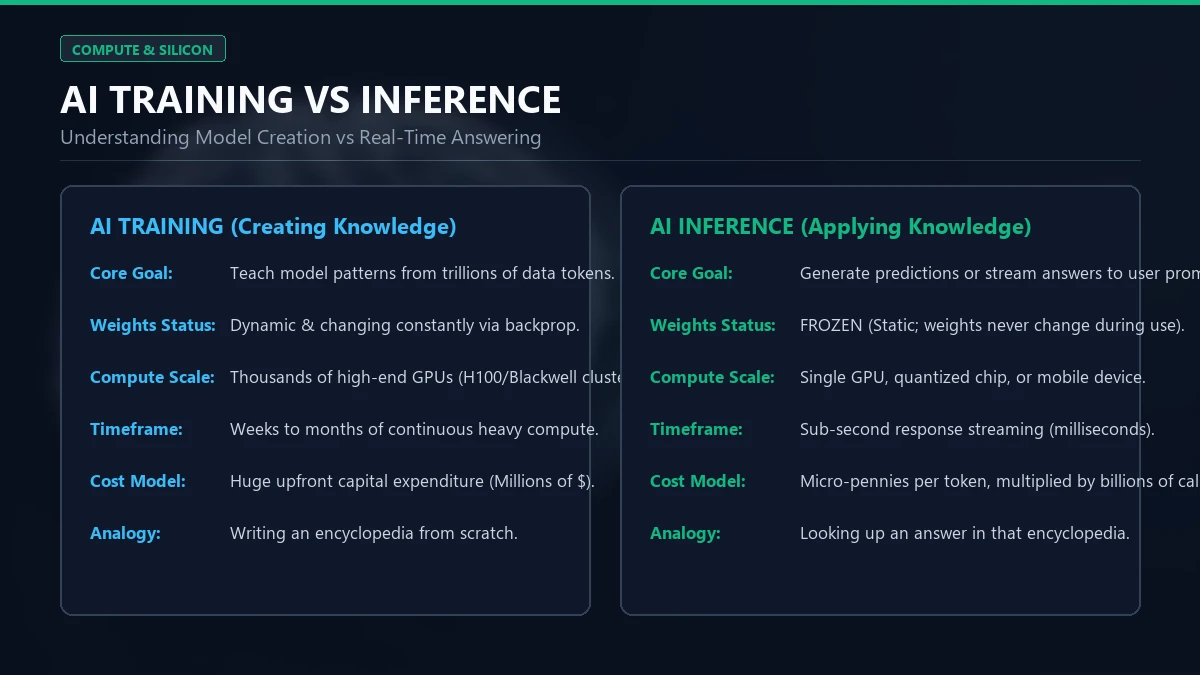
Side-by-Side Comparison: Training vs Inference
| Dimension | AI Training | AI Inference |
|---|---|---|
| Core Objective | Learn general patterns, language rules, and domain capabilities | Apply pre-learned knowledge to solve user queries in real time |
| Weights Status | Dynamic. Billions of parameters are continuously modified | Frozen. Parameters remain static and read-only during execution |
| Hardware Infrastructure | Massive GPU clusters (thousands of NVIDIA H100/B200s with ultra-fast NVLink networks) | Single GPU, specialized accelerator, CPU, or edge mobile processor |
| Time & Frequency | Runs over weeks to months in planned, batch-scheduled cycles | Executes continuously in sub-second responses (milliseconds) |
| Compute Direction | Two-way pass: Forward pass (prediction) + Backward pass (backpropagation) | One-way pass: Forward pass only (no backward gradient updates) |
| Cost Dynamics | Massive upfront capital expenditure (CapEx) per training run | Ongoing operational expenditure (OpEx) that scales with user query volume |
The Economic Shift: Why Inference Dominates Enterprise Budgets
While multi-million-dollar frontier training runs dominate headlines, enterprise AI economics are overwhelmingly driven by inference costs. A model is trained once every few months or quarters, but popular applications serve millions of queries every single day.
Over an application’s lifecycle, total inference expenditures routinely surpass original training costs by orders of magnitude. This reality has driven massive developer interest in deployment optimizations, including LLM quantization techniques, memory-efficient KV cache architectures, and dedicated production AI inference engines.
Hardware Requirements: Training Racks vs Inference Accelerators
The hardware required for training differs substantially from the hardware optimized for serving:
- Training Hardware: Requires colossal memory bandwidth, FP8/FP16 matrix math throughput, and ultra-high-speed node interconnects (like InfiniBand). Because weights and optimizer states must reside in memory simultaneously, models require clusters of enterprise GPUs.
- Inference Hardware: Optimized for low latency, energy efficiency, and cost per token. Many inference workloads run efficiently on smaller consumer GPUs, Apple Silicon unified memory, or specialized edge NPUs. When selecting servers, engineers evaluate GPUs versus CPUs for inference based on batch sizes and throughput targets, tracking context window memory demands.
Common Myths About Training and Inference
| Myth | Reality |
|---|---|
| “The AI learns from my conversation as I type.” | False. Model weights remain completely static during inference. The model utilizes conversational history only within its short-term context window. |
| “Inference is cheap, so you don’t need to optimize it.” | False. At scale, serving millions of tokens per second across thousands of active users quickly becomes an organization’s largest cloud expense. |
| “You need a cluster of H100 GPUs to run an LLM.” | False. Training requires clusters, but modern quantized 8B or 14B parameter models can run inference locally on laptops and small edge servers. |
| “Fine-tuning is just another word for inference.” | False. Fine-tuning is a targeted form of training that modifies a subset of model weights using specialized datasets. |
Frequently Asked Questions
What is the difference between AI training and inference?
AI training is the initial phase where a model learns patterns and language rules by adjusting internal weights across large datasets. Inference is the operational phase where the trained model applies that knowledge to answer new prompts in real time with frozen weights.
Is AI inference more expensive than training?
Per query, inference costs fractions of a cent, whereas training costs millions upfront. However, because inference repeats with every user request, total cumulative inference costs often exceed training costs over the operational lifespan of a successful product.
Does an AI model learn while running inference?
No. During inference, model parameters and weights are completely frozen. The model remembers prior messages in a conversation only because previous context is passed into the prompt input, not because the neural network updated its memory.
What is edge inference?
Edge inference refers to running AI models directly on local hardware—such as smartphones, personal computers, or embedded IoT chips—rather than routing requests to remote cloud data centers. This reduces latency, saves bandwidth, and preserves data privacy.
Where does fine-tuning fit between training and inference?
Fine-tuning is a specialized, lightweight training stage. It takes a pre-trained base model and continues training on a smaller, curated domain dataset to adapt model behavior, tone, or formatting before deploying the resulting checkpoint for inference.