
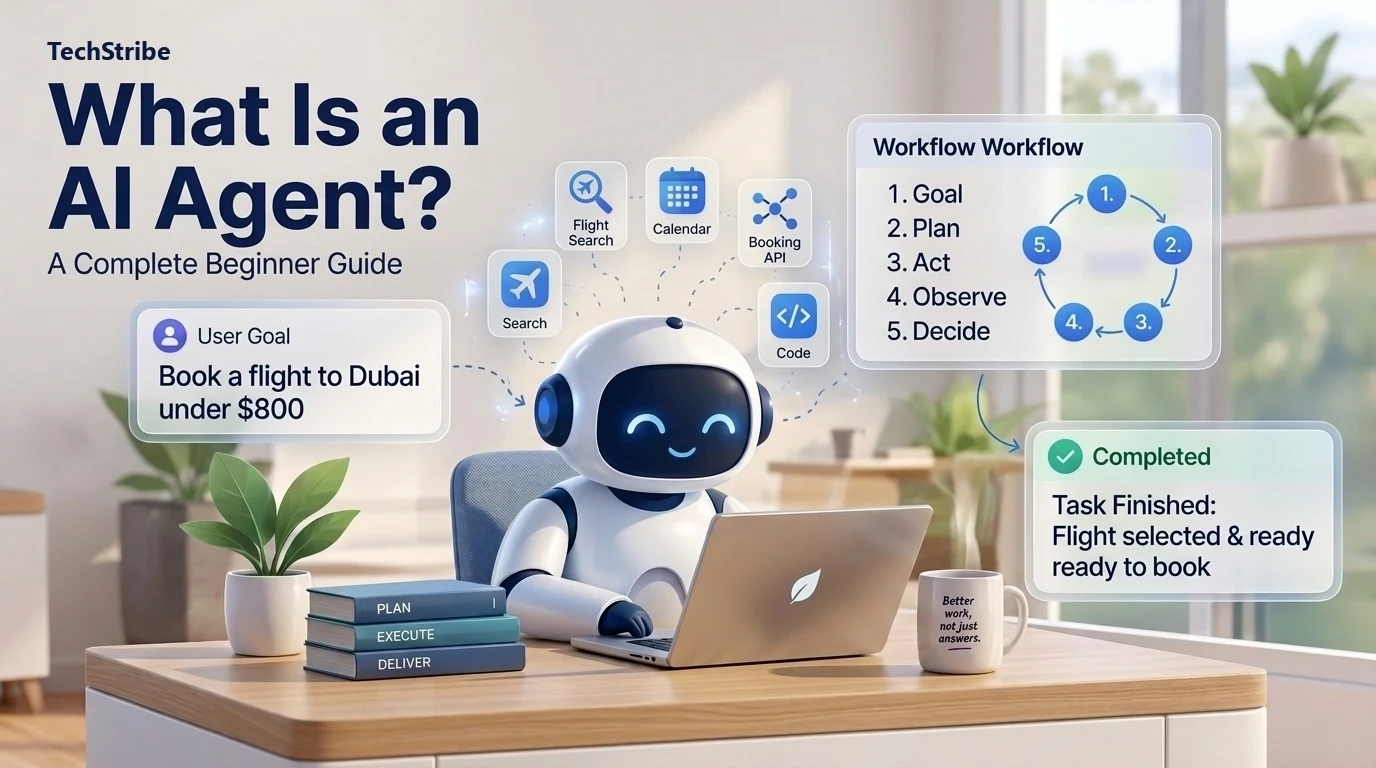
You ask the first assistant to help you plan a flight to Dubai. It writes a neat list of tips: pack light, book early, check the visa rules.
You ask the second assistant to do the same thing. It searches flight options, compares them with your budget, drafts an itinerary, and asks, “Want me to book this one?”
The first assistant answers. The second one acts.
That second assistant is much closer to what people mean by an AI agent. If you keep seeing the term in tool launches, job posts, and LinkedIn feeds and still are not sure what it means, this guide is for you. We shall keep it simple, and we shall be honest about what agents cannot do yet.
The Short Answer: What Is an AI Agent?
An AI agent is a software system that uses an AI model to work toward a goal. Instead of following a fixed script, it decides which steps to take, uses tools to take them, and checks the results before moving on.
One honest caveat: there is no single, universally accepted definition. Researchers who catalogue real agent systems say so openly, and companies use the word in different ways.
Anthropic offers a useful dividing line. In a workflow, code written by developers sets the path. In an agent, the AI model directs its own process and its use of tools. The more the model chooses the path, the more agent-like the system is.
AI Agent vs Chatbot vs Workflow
These terms get mixed up constantly. Here is a simple way to tell them apart:
| Terms | Who decides the steps? | Can it take actions? | Example |
|---|---|---|---|
| Chatbot | You. It replies to each message. | Usually not. It talks. | A help page bot answering FAQs |
| Workflow automation | A developer, in advance. | Yes, but only along a fixed path. | “When a form is submitted, send a welcome email” |
| AI agent | The AI model, as it goes. | Yes, through tools it chooses to use. | A coding assistant that writes code, runs tests, and fixes errors |
Real products often sit somewhere in between. Treat this as a spectrum, not three sealed boxes.
How Does an AI Agent Work?
Most agents run a continuous feedback loop. Rather than executing a static script, the system reasons through five core stages:
You state what you want
It picks a next step
It uses a tool or code
It reads the result
Repeat loop or finish
A quick example. Suppose you ask an agent: “Find broken links on my website and tell me which pages to fix first.” A well-built agent might:
- Plan: decide it needs a list of the site’s pages.
- Act: run a crawling tool to collect them.
- Observe: read which links return errors.
- Decide: rank the broken links by how important the page is.
- Finish: write a short report and stop.
The user never wrote those steps. The agent worked them out. That is the difference between an agent and a script.
The Four Parts of an AI Agent
| Part | What it does | Think of it as |
|---|---|---|
| Model | Reads the goal, reasons, and decides what to do next | The brain |
| Tools | Search, run code, call software, read databases, send requests | The hands |
| Memory | Keeps track of what has happened, sometimes across sessions | The notebook |
| Instructions & limits | Sets the rules, permissions, and when to ask a human | The job description |
Beginners tend to focus on the model and forget the tools. That is a mistake. Anthropic reports that while building its coding agent, its team spent more time refining the tools than the main prompt. A smart model with poor tools is like a skilled chef with a blunt knife.
Real World AI Agent Examples
- Coding agents: they write code, run tests, read the errors, and try again. Tests give the agent a clear way to check its own work, which is why coding is a popular use.
- Customer support agents: they read a question, look up the order, and take an action such as starting a refund, with rules about what they may do.
- Research agents: they gather sources, compare them, and draft a summary for a person to check.
- Website and SEO tasks: an agent can be set up to scan pages, flag issues, and draft a report. A human should still review what it finds before anything changes on the live site.
Running local models? To calculate whether your desktop or GPU can run local models for agents, check our AI Model VRAM Calculator.
Why AI Agents Matter to You
- If you’re a student: Agents are a practical way to learn prompting, APIs, and evaluation together. A small project, such as an agent that summarises your study notes into flashcards, teaches more than ten tutorials.
- If you work in a software house: Clients will ask for “an AI agent” when a plain workflow would do the job faster and cheaper. Knowing the difference helps you scope projects honestly.
- If you own a website or work in SEO: Many tools now carry the “agent” label. Ask what each one actually does; does it only suggest, or does it make changes? Clear structure, direct answers, and accurate content serve both human readers and AI systems that read your pages.
Limits and Risks
Agents are powerful, but they are not magic:
- They can be wrong with confidence. A fluent answer is not always a correct one.
- Errors can compound. A small mistake in step two can quietly spoil steps three to ten.
- They cost more and run slower than a single request, because they take many steps.
- Wide permissions are risky. An agent that can send emails or delete files should not do either without approval.
Frequently Asked Questions
What is an AI agent in simple words?
An AI agent is software that uses an AI model to reach a goal. It decides the steps, uses tools such as search or code, and checks its progress, rather than only replying to a prompt.
What is the difference between an AI agent and a chatbot?
A chatbot responds to what you type. An AI agent can take actions on its own, such as searching, running code, or updating a record, to complete a task you set.
What is agentic AI?
Agentic AI is a broad term for AI systems that act with some independence toward a goal. It includes both fixed workflows that call AI models and fully model directed agents.
How do AI agents work?
They run a loop: plan a step, use a tool, observe the result, then decide whether to continue or finish. Memory and rules keep them on track.
Are AI agents safe for business?
They can be, with limits. Give an agent the least access it needs, require human approval for risky actions, and test it on real examples before relying on it.
Can beginners build an AI agent?
Yes. Start with a simple workflow that calls an AI model, then add tool use step by step. Basic Python or JavaScript helps, and many platforms offer no-code options.




0 Comments
No comments yet. Start the conversation!