An AI assistant can give you a confident answer that is completely wrong. It might invent a court case with citations, quote an imaginary company policy, or recommend a software library that does not exist. The tone is calm, authoritative, and convincing—which makes the error especially dangerous.
In artificial intelligence, this is known as a hallucination. It is not a software bug in the traditional sense; it is a direct consequence of how large language models are built. This guide explains why AI models hallucinate in plain English and outlines seven practical engineering defenses developers can use to reduce the risk.
The Short Answer
- LLMs do not search a factual database when answering. They are probabilistic next-token prediction engines designed to generate plausible text.
- Hallucinations happen when knowledge gaps, vague prompts, or pre-training statistical biases steer the model toward plausible-sounding fabrications.
- You cannot eliminate hallucinations completely with prompting alone, but you can dramatically reduce their occurrence using grounding (RAG), strict schema validation, and guardrails.
What Is an AI Hallucination?
A hallucination occurs when an AI model generates output that is factually incorrect, nonsensical, or unfaithful to the source material provided, while presenting it as truth.
Hallucinations typically fall into three categories:
| Hallucination Type | What It Looks Like | Primary Defense |
|---|---|---|
| Factual Invention | The model fabricates dates, biographical details, statistics, or software APIs | Grounding responses via retrieval-augmented generation (RAG) |
| Unfaithful Summary | The model contradicts or adds unverified claims not present in the provided document | Strict system instructions requiring explicit quotation and citation of provided context |
| Source Fabrication | The model invents academic papers, author names, or broken URLs to back up claims | Algorithmic validation against vector database search results |
The Root Cause: Why AI Models Hallucinate
To prevent hallucinations, engineers must understand how LLMs generate text:
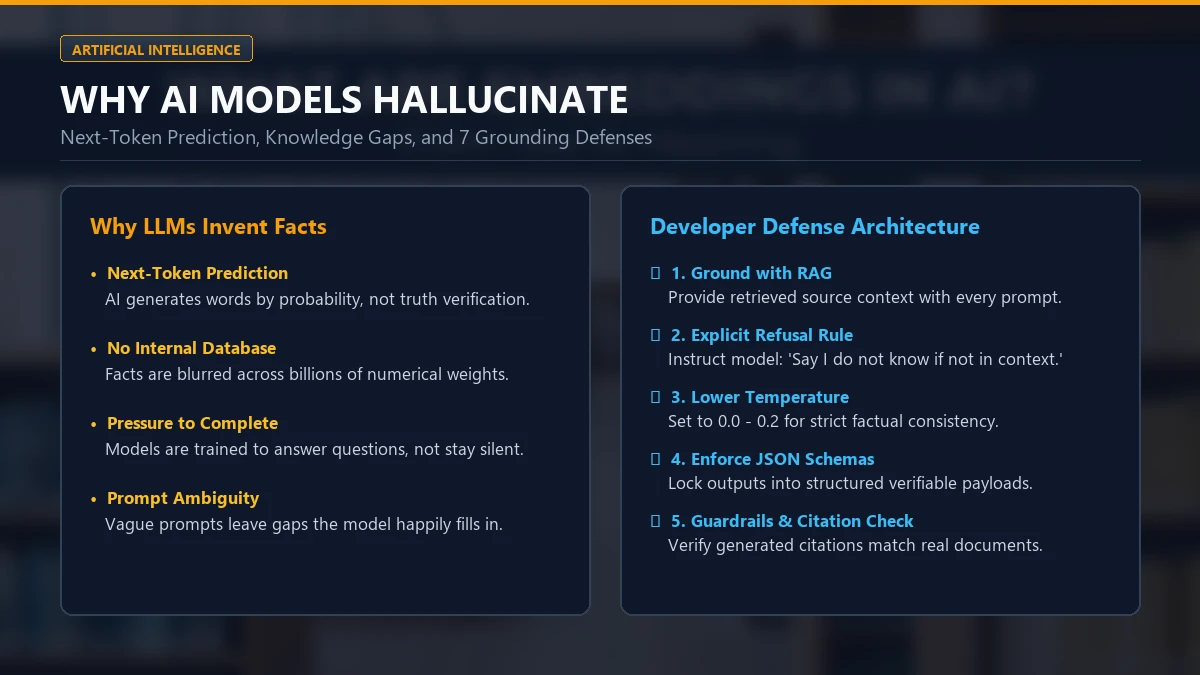
- Next-token prediction: At its core, an LLM predicts the most statistically probable next word (or token) given preceding text. It evaluates mathematical probability, not objective reality.
- No built-in fact verification: An LLM possesses no internal concept of truth versus falsehood. Plausible fiction and verified truth look identical to statistical language patterns.
- Training data compression: Frontier models compress petabytes of internet text into numerical parameters. Factual knowledge is blurred across billions of mathematical weights.
- Pressure to complete: Standard models are trained via RLHF (Reinforcement Learning from Human Feedback) to be helpful. When a model lacks specific knowledge, it often prioritizes providing a complete answer over admitting ignorance.
7 Practical Defenses to Reduce Hallucinations
1. Ground Answers with Retrieved Context (RAG)
The single most effective defense against factual hallucinations is grounding. Instead of asking the model to recall facts from its compressed weights, search your verified knowledge base and supply the relevant text inside the prompt. Confining answers to in-context retrieved documents forces the model to synthesize rather than invent.
2. Explicitly Authorize “I Don’t Know”
By default, models attempt to answer even when information is missing. Include clear, explicit negative constraints in your system prompt:
System Prompt Pattern: “Answer the user’s question using ONLY the provided context below. If the answer cannot be found directly in the text, respond with: ‘I do not have enough information to answer that question.’ Do not extrapolate or guess.”
3. Lower the Model Temperature
Temperature controls randomness during token generation. For creative writing, a temperature of 0.7 to 1.0 adds variety. For enterprise documentation, customer support, and code generation, set the temperature between 0.0 and 0.2 to select the most probable, deterministic tokens.
4. Enforce Structured Outputs (JSON Schemas)
Freeform prose invites creative drift. By enforcing strict JSON schemas (using OpenAI Structured Outputs or Pydantic validation), you force the model to fill predefined keys (e.g., "answer", "source_quote", "confidence_score"). Constraining syntax significantly curbs tangential fabrications.
5. Require Verifiable Quotes and Citations
Instruct the model to cite exact word-for-word excerpts from the retrieved context to justify its answer. You can then run a simple programmatic string-matching check in your backend to verify that the cited quote actually exists in the source text before returning the response to the user.
6. Implement Multi-Step Verification
In high-stakes agentic workflows, deploy a two-step generation pipeline. Have Model A generate the draft answer, then have a smaller, specialized Model B verify whether every factual assertion in Model A’s response is supported by the source text, reinforcing security guardrails across agent decision pipelines.
7. Implement Human-in-the-Loop for Sensitive Actions
For high-risk operations—such as medical diagnosis, financial advice, or executing irreversible database queries—never let an autonomous model publish or act without human review. Design systems where the AI prepares recommendations, and human operators approve them.
Grounding in Action: Before and After
| Setup | Model Response | Outcome |
|---|---|---|
| Ungrounded Prompt: “What is our company’s return policy for software?” |
“We offer a full refund within 30 days of purchase with proof of receipt.” | Hallucination: Sounds completely professional, but contradicts internal policy (which states digital software licenses are non-refundable). |
| Grounded Prompt (RAG): “Using only the context provided, answer: What is our return policy for software?” |
“According to Section 4.2 of the License Agreement, software licenses are non-refundable once the activation key has been redeemed.” | Accurate & Grounded: Directly reflects verified company documentation with exact clause reference. |
Frequently Asked Questions
Why do AI models hallucinate?
AI models hallucinate because they are trained to predict the most probable sequence of words rather than verifying factual truth. When they encounter gaps in training data or ambiguous prompts, they generate statistically plausible text that may be completely untrue.
Can you completely eliminate AI hallucinations?
No. Because LLMs are inherently probabilistic, hallucination risk cannot be reduced to absolute zero. However, combining retrieval-augmented generation (RAG), low temperature settings, schema constraints, and verification guardrails can reduce hallucination rates to negligible levels.
Are larger AI models less likely to hallucinate?
Not necessarily. While larger frontier models have broader knowledge and better reasoning capabilities, they are also capable of generating more sophisticated, subtle, and convincing fabrications. Grounding architecture matters far more than model size alone.
How do developers detect AI hallucinations in production?
Developers use automated faithfulness evaluations (such as Ragas or TruLens), LLM-as-a-judge verification pipelines, citation-matching regex algorithms, and continuous user feedback monitoring.
What is the difference between an AI hallucination and a bug?
A software bug is a deterministic coding error where code executes incorrectly. A hallucination is an emergent property of probabilistic neural networks generating plausible-sounding language without factual grounding.