A developer tests a new AI chatbot with five questions. All five answers look great. The team celebrates and ships it on Friday. By Tuesday, a customer pastes in a long, messy email that mixes two languages and asks three things at once. The bot answers a completely different question, with total confidence. Nobody tested for that, because nobody knew to.
This is the gap that LLM evaluation closes. A large language model can look brilliant on a handful of clean demo prompts and still stumble on the cases your real users bring. This guide shows you how to evaluate an LLM before production in seven practical steps that work even without a dedicated machine learning team.
The Short Answer
- Define success first: Decide exactly what a good answer looks like before testing anything.
- Test with real questions: Synthetic demo questions hide edge-case failure modes.
- Measure beyond accuracy: Safety, latency, and token cost decide whether a model is practically usable.
- Test after every change: Treat evaluations as release gates and monitor production drift continuously.
Why a Good Demo Is Not an Evaluation
Traditional software breaks deterministically: you reproduce the bug, fix the logic, and write a test. LLMs are probabilistic. The same prompt can produce different phrasing across runs, and a minor backend update from your API provider can silently alter system behavior.
Furthermore, public AI benchmarks measure general knowledge across academic tests rather than your private data, business logic, or customer personas. Rare edge cases that never appear on public leaderboards frequently become the everyday failures in live deployments.
Step 1: Define What “Good” Means
Write down what success looks like in plain language before running a single test. Divide requirements into two categories:
- Quality requirements: Answers must be factually correct, grounded in your approved documentation, adhere to brand tone, and avoid generating harmful outputs.
- Operational guardrails: End-to-end response latency, cost per thousand tokens, and API error rates must remain within acceptable bounds.
Example: For a customer support bot, success means: responses strictly match knowledge base articles, the system explicitly states “I don’t know” when queries fall outside the documentation, and answers stream fast enough that users do not abandon the chat.
Step 2: Build a Test Set From Real Questions
Your test set is the foundation of the entire evaluation workflow. Construct it using authentic operational data:
- Real customer support tickets, chat transcripts, internal search logs, and FAQ inquiries.
- A balanced mixture of straightforward, typical, and difficult multi-part queries.
- Edge cases: extremely short prompts, massive text dumps, typos, and multilingual inputs.
- Past failures: every time an AI app fails in staging or production, add that exact case to your test suite.
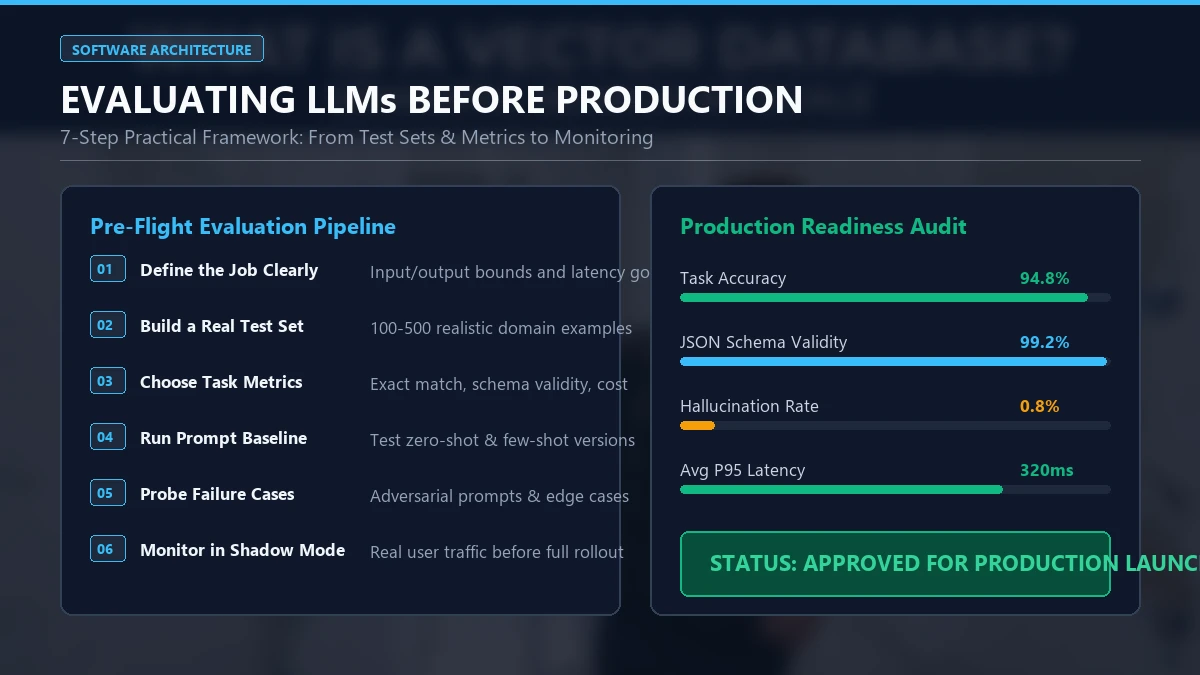
For each test item, define the expected answer or a checklist of mandatory factual elements. Maintain a “golden dataset” of 100 to 500 validated examples to evaluate future model versions consistently.
Step 3: Pick Metrics Beyond Accuracy
Accuracy alone does not indicate whether an LLM is production-ready. Score your system across multiple evaluation dimensions:
| Dimension | Question It Answers | How to Measure |
|---|---|---|
| Task Accuracy | Is the output correct and helpful for the user’s goal? | Compare outputs against golden reference answers |
| Faithfulness | Does the response stick strictly to the retrieved context? | Verify each generated claim against the provided documents in your RAG architectures |
| Hallucination | Does the model invent facts, citations, or data? | Prompt with questions that provided data cannot answer and check for fabricated claims |
| Safety & Toxicity | Does it produce offensive, toxic, or private content? | Run red-teaming adversarial prompts to test guardrails |
| Robustness | Does it handle messy inputs, noise, and prompt attacks? | Test typos, unstructured text dumps, and prompt injection attempts |
| Consistency | Are repeated outputs stable across multiple runs? | Execute identical prompts across multiple temperature settings and compare variance |
| Latency & Cost | Is the application scalable and economically viable? | Measure time-to-first-token (TTFT), total response time, and token cost per query |
Step 4: Test the Hard Cases
Happy-path prompts are easy to pass. The true operational risk hides in edge cases. Test these deliberately before launch:
- Unanswerable queries: Verify that the model responds with “I do not have access to that information” rather than hallucinating plausible details.
- Prompt injections: Test adversarial instructions embedded in user queries or external data to ensure the model does not bypass system rules.
- Tool boundary security: When integrating external APIs via Model Context Protocol tools, verify strict permission boundaries and input sanitation following best practices for securing MCP server connections.
- Conflicting information: Test how the system responds when two retrieved documents present contradictory policies.
- Context overflow: Ensure system prompts remain functional when user inputs push up against prompt context limits.
Step 5: Combine Automated Checks, AI Judges, and Humans
No single evaluation method catches every failure mode. High-performing engineering teams combine three layers:
- Automated unit checks: Programmatic validation for response length, JSON schema compliance, regex checks, and keyword presence. Cheap, fast, and deterministic.
- LLM-as-a-judge: Using a powerful frontier model to evaluate candidate responses against an explicit grading rubric. Scalable and fast, but requires initial calibration against human ratings.
- Human expert review: Experienced team members manually scoring a sampled slice of outputs. Slower and more expensive, but essential for evaluating subtle nuance, tone, and brand safety.
Step 6: Compare Against a Baseline
An evaluation score has little meaning in isolation. Establish a clear baseline using your existing setup or an established prompt version. When iterating:
- Change one variable at a time—isolate whether improvements come from system prompt tuning, model switching, or vector retrieval parameters.
- Run every candidate model across the exact same evaluation dataset.
- Maintain an evaluation log recording scores, latencies, and token costs for every deployment candidate.
Step 7: Set Release Gates and Keep Monitoring
Evaluation is an ongoing operational discipline, not a one-time launch checklist:
- Define hard pass gates: Require candidate models to achieve minimum thresholds (e.g., 95% faithfulness, <1% hallucination rate) before shipping to production.
- Automate regression evals: Run your golden test suite automatically inside CI/CD pipelines whenever code, prompts, or model endpoints change.
- Canary deployments: Route 5% of live traffic to the new model variant before full deployment.
- Monitor production drift: Track user thumbs-up/down ratings, retry rates, and safety alerts in live monitoring dashboards.
Pre-Launch Evaluation Checklist
- [ ] Success criteria and unacceptable failure modes documented in writing.
- [ ] Test set created with 100+ authentic user queries and edge cases.
- [ ] Faithfulness, hallucination, latency, and token cost scored alongside accuracy.
- [ ] Baseline established and logged for regression tracking.
- [ ] Human domain experts reviewed a representative sample of test outputs.
- [ ] Fallback mechanisms, timeout rules, and rollback plans deployed.
Frequently Asked Questions
How do you evaluate an LLM before production?
Define clear success criteria, build a test dataset from authentic user queries, score the model on accuracy, faithfulness, safety, speed, and cost, test edge cases rigorously, compare results against a baseline, and enforce minimum release gates.
What metrics should I use to evaluate an LLM?
Start with task accuracy, faithfulness to provided context, hallucination frequency, and safety guardrails. Then evaluate operational metrics including time-to-first-token (TTFT), end-to-end latency, and cost per query.
What are LLM evals?
LLM evals are standardized, automated, and repeatable test suites used to measure the quality, accuracy, safety, and performance of large language model applications against predefined criteria.
What is LLM-as-a-judge, and is it reliable?
LLM-as-a-judge is an evaluation technique where a powerful model grades candidate outputs based on written rubrics. It is reliable and scalable for high-volume testing, provided you calibrate its scores against human expert ratings first.
How big should an LLM evaluation test set be?
Start with a carefully curated set of 50 to 100 representative examples that you understand thoroughly. As your application runs in production, continuously add observed failure modes and edge cases to grow the suite to several hundred items.
How often should I re-evaluate an LLM application?
Re-run your evaluation suite every time you change a system prompt, update retrieval parameters, switch model providers, or deploy new tools. Additionally, monitor production logs continuously for behavioural drift.