Monday morning. A colleague forwards a headline: a new AI model tops the leaderboard. Your manager adds one line: “Should we switch?” You open the article and find a chart full of bars, names like MMLU and GPQA, and percentages that all look impressive. But what do they actually mean? And does a high number on that chart mean the model will do well on your work?
That is the question behind AI benchmarks. This guide explains what benchmark scores tell you, what they leave out, and how to read them without getting fooled.
The Short Answer
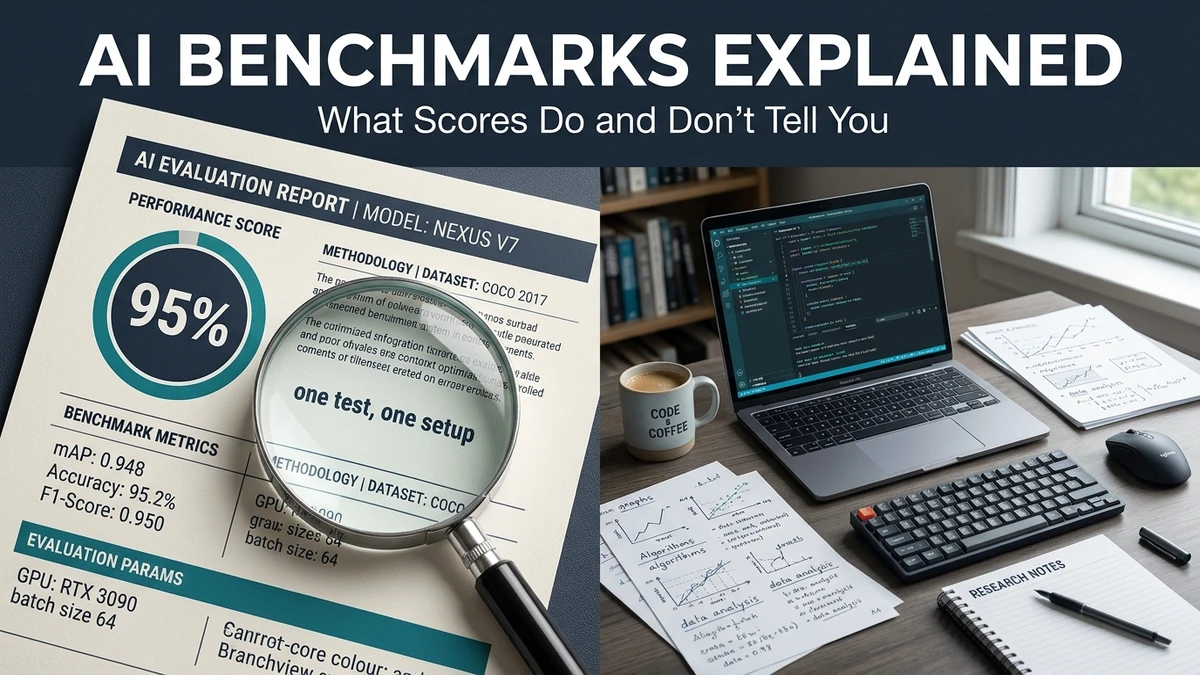
- A score shows how a model did on one test, under one set of conditions.
- It does not show how the model will do on your specific tasks, your private data, or your budget.
- Use benchmarks to build a shortlist, then test the finalists yourself on real examples from your work.
What Is an AI Benchmark?
An AI benchmark is a standard test. It has a fixed set of questions or tasks and a fixed way of scoring answers, so different models can be compared fairly. Think of it as an exam: same paper, same marking, different students.
Benchmarks matter because they give the industry a shared yardstick. Without them, every company could simply claim its model is the best. Whether evaluating general reasoning or specialized autonomous AI agents, standard evaluations provide a baseline comparison.
Score Words You Will See
Most scores look like a simple percentage, but the meaning behind the number changes from test to test:
- Accuracy: The share of questions the model answered correctly.
- Pass rate: The share of coding tasks where the model’s code passed the test cases.
- Preference or win rate: How often people picked the model’s answer over another in a blind vote.
- Leaderboard: A ranked list of models on one or more tests.
Always check how “right” was decided. An exact match, a passing test, and a popular vote measure very different things.
Common Benchmarks at a Glance
Different benchmarks test different slices of ability. Here are well-known evaluation styles and what each can miss:
| Benchmark Style | What It Tests | What It Can Miss |
|---|---|---|
| MMLU-style | Multiple-choice questions across many school and professional subjects | Real writing, long conversations, up-to-date facts, and large context window limits |
| HumanEval-style | Writing short Python functions that pass unit tests | Large codebases, complex debugging, refactoring, team workflows |
| GPQA-style | Hard graduate-level science and reasoning questions | Everyday business tasks, practical customer queries |
| SWE-bench-style | Fixing real GitHub issues from open-source software projects | Tasks outside those specific repositories, frameworks, and languages |
| Chatbot Arena-style | Which answer people prefer in blind pairwise comparisons | Factual accuracy, since human voters often favor confident style over substance |
What Benchmark Scores Do Tell You
Benchmarks are not useless. Used carefully, they provide valuable signals:
- A rough capability tier: Strong and weak models usually separate clearly on hard tests.
- Progress over time: The same fixed test shows whether new architecture versions improve.
- Relative strengths: One model may lead in coding and another in complex knowledge retrieval.
- A starting shortlist: Scores help you quickly eliminate models that are clearly behind before testing embedding models or specialized architectures.
5 Reasons a High Score Can Mislead
1. Contamination
Contamination happens when test questions leak into a model’s pre-training or fine-tuning dataset. Because public benchmarks are widely shared and discussed online, this leakage is difficult to prevent. The model may simply recall answers it has seen before, rather than reasoning through problems.
2. Saturation
When leading models all score near the ceiling (e.g., 90%+), the test can no longer separate them effectively. A study of 60 LLM benchmarks found that nearly half showed saturation. If two top models score a point apart on a saturated test, that fractional gap tells you almost nothing about real-world superiority.
3. Selective Reporting
Model developers choose which benchmarks to publish in announcement blog posts. A marketing chart highlights the tests a model wins while quietly skipping those where competitors excel. Settings also vary widely—such as prompt templates, few-shot examples, or tool use permissions—making numbers impossible to compare side-by-side.
4. Narrow or Flawed Tests
Some benchmark questions contain errors, ambiguities, or outdated assumptions. Furthermore, multiple-choice quizzes are completely disconnected from how developers actually deploy AI: open-ended queries, structured JSON payloads, and integrations with retrieval-augmented generation (RAG) benchmarks.
5. Your Task Is Different
A standardized benchmark knows nothing about your business logic, your private schemas, your users’ language, or your latency budgets. A model that tops a general leaderboard might fail in production when deploying quantized open-source models under strict hardware limits.
How to Read a Benchmark Table
- Check who ran the test: Was it the vendor selling the model, or an independent research group?
- Check the test settings: Look for prompt engineering style, temperature, number of tries (pass@1 vs pass@10), and external tools allowed.
- Look at several benchmarks: Never rely on a single headline number or PR release.
- Prefer dynamic benchmarks: Regularly refreshed tests with private splits are far less prone to data contamination and saturation.
- Look beyond raw quality: Price per million tokens, time-to-first-token (TTFT), throughput, and memory footprint determine real viability.
- Run your own evaluation: Test finalists against your private dataset and practical business scenarios.
Rule of Thumb: If a vendor claim does not state which benchmark was used, who ran it, under what exact prompt settings, and when, treat it as marketing rather than engineering evidence.
Four Benchmark Myths vs Reality
| Myth | Reality |
|---|---|
| The highest score means the best model. | It only means the best score on that specific test under those specific conditions. Small margins between top models mean very little. |
| Human-level score means human-level understanding. | Matching humans on multiple-choice questions does not demonstrate human understanding. It only proves the model matches pattern distributions on that test. |
| Keeping test data secret solves contamination. | Hiding test data shows limited long-term protection. Rigorously expert-designed tests hold up better than crowdsourced test suites. |
| A new benchmark cannot be gamed. | Any metric that becomes a target eventually ceases to be an objective measure. New benchmarks age quickly as developers optimize for them. |
A One-Hour Test You Can Run Yourself
You do not need an enterprise evaluation platform to get started. Try this simple evaluation loop with a shortlist of two or three models:
- Collect 15 to 20 real tasks: Gather authentic examples from your workflow, such as customer tickets, document summarization requests, or tricky code snippets.
- Run the same tasks: Feed the exact same inputs and system instructions to each candidate model.
- Score outputs consistently: Rate each response as good, acceptable, or poor. Have a teammate score a sample blindly.
- Track operational metrics: Record response latency and token costs alongside output quality.
- Pick the practical winner: Choose the model that handles your real tasks reliably, rather than the one topping public charts.
Frequently Asked Questions
What is an AI benchmark?
An AI benchmark is a standardized test with fixed tasks, datasets, and scoring rules used to evaluate and compare the performance of different artificial intelligence models objectively.
What do AI benchmark scores actually tell you?
They indicate how a model performed on a specific dataset under specific test conditions. They serve as useful indicators for broad capability tiers and shortlisting, but cannot predict performance on your domain data.
Are AI benchmarks reliable?
They provide useful baseline signals, but are inherently limited by data contamination, benchmark saturation, selective vendor reporting, and narrow test formats.
What is benchmark contamination?
Benchmark contamination occurs when evaluation questions or answers leak into a model’s training data, causing the model to memorize answers rather than demonstrating true generalized problem-solving ability.
What is benchmark saturation?
Saturation happens when state-of-the-art models all achieve near-perfect scores on a benchmark, making it impossible for the test to distinguish performance differences between top models.
Which AI benchmark is the best?
No single benchmark is best. The ideal evaluation depends entirely on your target workload—such as code generation, mathematical reasoning, multi-turn dialog, or domain knowledge.
How do I choose an LLM if benchmarks are unreliable?
Use public benchmarks only to filter down to a shortlist of two to three candidates. Then, run an internal evaluation on 20 to 100 real-world examples from your actual application to compare accuracy, speed, and cost.