Your AI assistant keeps giving wrong answers, and everyone on the team has a different fix. The machine learning engineer says: “We need to fine-tune a model on our internal data.” The backend lead says: “No, fine-tuning is expensive and slow. We should build a RAG pipeline instead.”
Both are popular ways to make an AI model more useful for your business, but they solve completely different problems. Choosing the wrong approach costs weeks of engineering time and thousands of dollars in wasted compute. This guide explains RAG vs fine-tuning in plain English, compares them across cost, freshness, and accuracy, and gives you a simple decision checklist.
The Short Answer
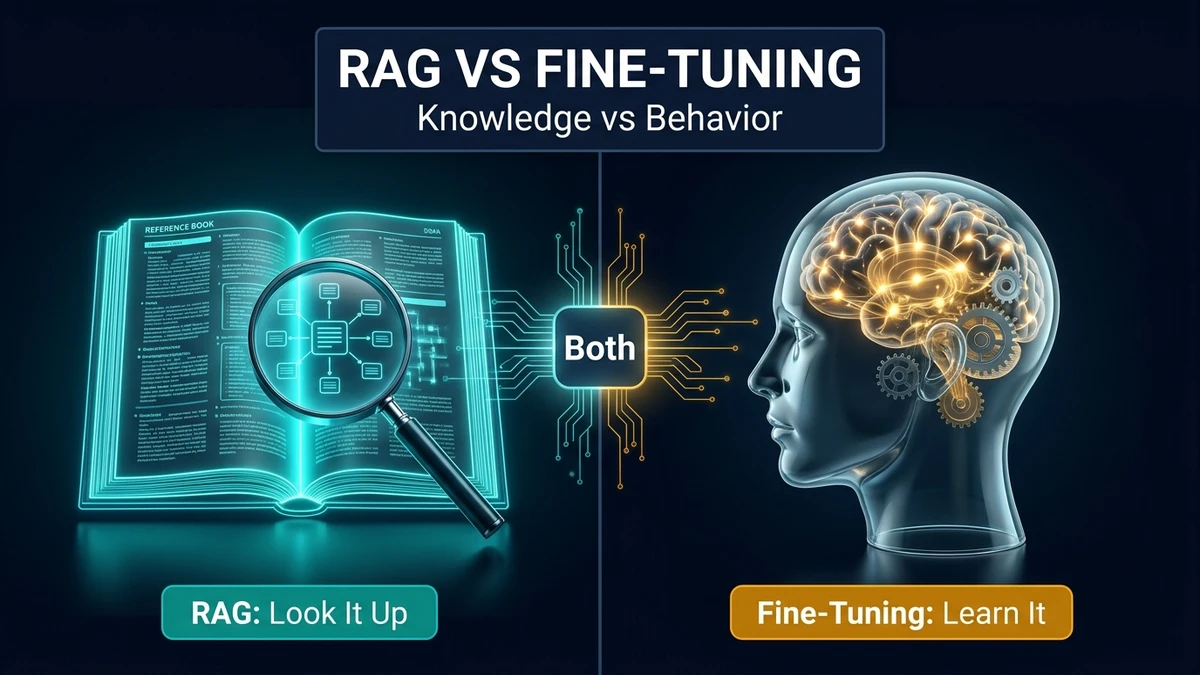
- RAG (Retrieval-Augmented Generation) is for giving a model new or changing knowledge. Think of it like giving the model an open-book library to search before answering.
- Fine-tuning is for teaching a model a new style, structure, or specialized behavior. Think of it like intensive study that changes how the model thinks and writes.
- Rule of Thumb: If your facts change, choose RAG. If your desired tone, formatting, or task behavior is specialized, choose fine-tuning. Many production architectures use both together.
What Is RAG (Retrieval-Augmented Generation)?
Retrieval-Augmented Generation adds a dynamic search step before the language model generates an answer. When a user asks a question, the system searches your private documents, selects the most relevant text chunks, pastes them into the prompt as context, and tells the model: “Answer the user’s question using only this provided information.”
A typical implementation relies on generating vector embeddings from your documentation, indexing them inside vector databases, and executing semantic similarity search at runtime. Because knowledge lives in the database rather than the model weights, updating information is as simple as adding or modifying documents in your RAG pipeline architecture.
What Is Fine-Tuning?
Fine-tuning takes an existing pre-trained model and trains it further on a curated dataset of prompt-and-response pairs. Unlike pre-training from scratch, which requires millions of dollars and billions of parameters, fine-tuning adjusts existing weights to master specific formatting conventions, domain terminology, or structured output schemas.
Fine-tuning alters the internal weights of the model. Once trained, those patterns become permanent habits. Techniques like LoRA (Low-Rank Adaptation) allow developers to adapt models cost-effectively, and teams often deploy them using quantizing fine-tuned weights to minimize operational VRAM requirements.
Side-by-Side Comparison: RAG vs Fine-Tuning
Here is how the two approaches compare across the core dimensions that matter in production engineering:
| Dimension | RAG (Retrieval-Augmented Generation) | Fine-Tuning |
|---|---|---|
| Primary Purpose | Providing factual knowledge, current data, and verified sources | Teaching specialized tone, output structure, style, and domain behavior |
| Data Freshness | Instant. Update the database and the model accesses new data immediately | Static. Requires retraining and re-deploying weights to update information |
| Setup Cost & Time | Lower initial compute cost. Requires setting up search and retrieval infrastructure | Higher initial compute cost. Requires preparing curated datasets and running GPU training |
| Operational Complexity | More moving parts in production (embedding generation, vector indexing, reranking) | Simpler serving architecture once trained (a single model endpoint) |
| Source Citations | Native and straightforward. Direct reference links to retrieved source chunks | Difficult. Cannot reliably cite sources from internal weight memory |
| Hallucination Risk | Low. Strongly grounded in retrieved documents provided in the prompt | Moderate. Model can still hallucinate outdated or fabricated details |
| Access Control | Simple. Filter search results based on user identity and permission roles | Hard. All knowledge baked into weights is accessible to any user querying the model |
When to Choose RAG
RAG is the right architectural choice when your application meets any of these criteria:
- Your content changes frequently: Prices, inventory catalogs, policies, support docs, and market news update daily.
- Users require verifiable citations: In legal, healthcare, or financial domains, users must click through to inspect the underlying source document.
- Role-based access control matters: Different users have different access permissions (e.g., HR records vs engineering documentation). RAG allows access filters at the search stage.
- You want fast time-to-market: You can build a functioning RAG prototype in days without building complex training pipelines.
When to Choose Fine-Tuning
Fine-tuning is the optimal path when your engineering goals revolve around behavioral consistency:
- Strict output formatting: You need an LLM to reliably output complex, domain-specific JSON, SQL, or code schemas without deviation.
- Consistent brand tone and style: You are training an AI to write exactly like your editorial voice or follow rigid legal phrasing.
- Latency and token cost reduction: You want to avoid stuffing long few-shot prompts and instructions into the context window on every API call.
- Distilling capabilities into smaller models: Fine-tuning allows an efficient 8B parameter model to outperform a massive 70B parameter general model on a narrow, specific task.
Why Production Teams Use Both Together
RAG and fine-tuning are not mutually exclusive rivals. In advanced production systems, combining both patterns often yields the highest performance:
Example: An enterprise legal assistant uses fine-tuning to train a compact open-weights model to understand complex statutory terminology and format answers in standardized legal briefs. Then, the system connects that fine-tuned model to a RAG pipeline that searches current court filings and case law. The fine-tuning teaches the model how to communicate, while RAG gives it what to know, complementing long-term AI memory mechanisms.
Decision Checklist: Which Approach Should You Choose?
- Does your task require up-to-date facts or private documents? → Start with RAG.
- Do users need to see and verify source citations? → Choose RAG.
- Is your primary bottleneck prompt formatting, tone, or schema consistency? → Choose Fine-Tuning.
- Do you have thousands of high-quality input-output pairs ready? → If no, start with RAG.
- Are you trying to replace a massive general model with a faster, cheaper small model? → Choose Fine-Tuning.
Frequently Asked Questions
What is the difference between RAG and fine-tuning?
RAG connects a language model to an external search system to retrieve relevant knowledge at query time. Fine-tuning adjusts the internal weights of the model by training it on specific examples to master specialized behavior, style, or syntax.
Which is cheaper: RAG or fine-tuning?
RAG is generally much cheaper to start with because it requires no GPU training compute. Fine-tuning requires significant upfront preparation and compute costs, though it can lower ongoing inference costs if it allows you to shorten prompt context lengths.
Can you combine RAG and fine-tuning?
Yes. Many production applications fine-tune a model to master domain language and response schemas, then connect it to a RAG pipeline so it accesses live, verified information.
Does fine-tuning stop hallucinations?
No. Fine-tuning teaches models new patterns and styles, but it does not prevent models from fabricating facts. Grounding outputs in verified documents via RAG is far more effective for reducing hallucinations.
Does RAG require a vector database?
Vector databases are the most common storage solution for semantic retrieval, but they are not strictly required. Many successful RAG pipelines use BM25 keyword search, relational database queries, or hybrid search systems.