In Brief: A newly published Microsoft patent application outlines an AI pipeline that listens to live speakers, rewrites their dialogue, and redraws their lip and facial movements on the fly within seconds—enabling instant translation, live polish, and personalized broadcasts, while raising major real-time deepfake concerns.
Picture a keynote speaker who says “um” nine times a minute. Now picture your viewing screen quietly deleting every single hesitation, and photorealistically redrawing the speaker’s mouth so you never notice the cut.
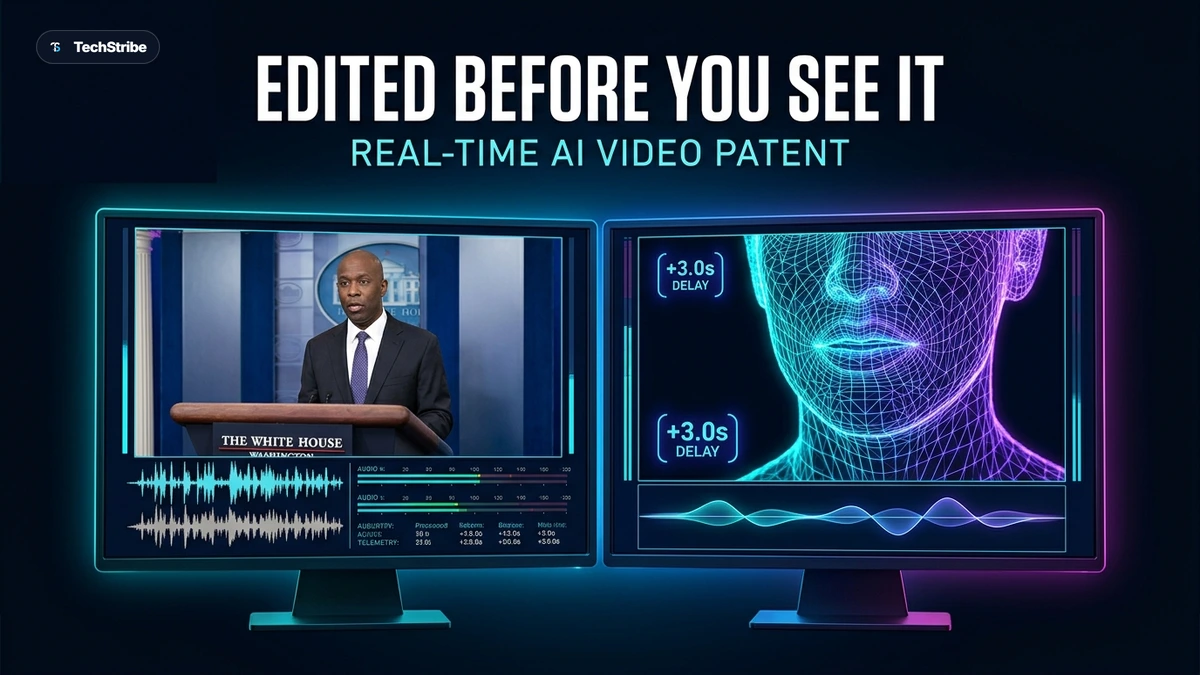
That is the premise behind a newly published Microsoft patent for real-time AI video editing. It describes software that listens to live audio, alters selected words or phrases, and generates matching lip and facial movements within seconds.
Context Note: This analysis explores patent application US 2026/0341309 A1. Patents describe technical concepts and proposed systems, not confirmed shipping consumer products.
The Patent at a Glance
| Detail | What the Filing Shows |
|---|---|
| Publication Number | US 2026/0341309 A1 |
| Applicant | Microsoft Technology Licensing, LLC |
| Inventors | David Callaghan and Dinesh Kumar |
| Filing Date | April 29, 2025 |
| Publication Date | October 29, 2026 |
| Claims | 20 distinct claims |
| Current Status | Pending (Patent examiner raised routine prior-art objections) |
| Scope Description | Near real-time AI enhancement of video or augmented reality presentations of live events |
How It Works, Step by Step
According to the patent claims, the system operates as a tightly synchronized processing pipeline. “Near-real-time” is technically defined within the document as a latency window between 1 and 10 seconds.
| Step | Pipeline Stage | Operational Mechanism |
|---|---|---|
| 1 | Capture | High-definition cameras and microphones capture live speech and visual feeds. |
| 2 | Scan | An AI agent listens to incoming audio, identifying words to modify based on predefined rules and viewer profiles. |
| 3 | Rewrite | The system selects replacement vocabulary via rule sets, translation models, or live web search retrieval. |
| 4 | Generate | A generative AI engine synthesizes the replacement dialogue in both audio tone and synchronized video. |
| 5 | Redraw | Neural facial synthesis redraws the speaker’s mouth, jawline, and facial expressions to match the replacement syllables. |
| 6 | Blend | The pipeline interpolates audio and visual frames before and after the modification to ensure imperceptible seams. |
| 7 | Display | The edited stream renders on the viewer’s device—such as AR smart glasses, smartphones, laptops, or broadcast monitors. |
Why the Latency Buffer Matters: The audience watches the event on a 1-to-10-second delay behind reality. That narrow latency buffer gives the AI pipeline sufficient time to transcribe, evaluate, rewrite, redraw, and blend the video frames seamlessly, balancing local edge device processing with scalable cloud computing infrastructure.
Why Doing This Live Is Exceptionally Difficult
The patent outlines a functional pipeline, but delivering broadcast-quality live neural editing introduces severe engineering bottlenecks:
- Extreme Latency Budgets: Transcription, language inference, neural voice cloning, and high-resolution facial rendering must all execute within a tiny window of a few seconds.
- Phoneme-Viseme Timing Mismatches: Translated or substituted phrases rarely occupy the exact duration of original speech. The mouth movements and audio speed must be dynamically warped to prevent desynchronization.
- Zero Tolerances for Glitches: Unlike offline post-production studio dubbing, a live broadcast offers no opportunity for a second render pass if a frame artifacts or tears.
- Massive Compute Demands: The patent filing proposes that processing could occur locally on the viewer’s device hardware, requiring dedicated NPUs and specialized AI hardware accelerators. For engineers calculating the local memory footprint of generative models, our LLM VRAM calculator details the resource constraints involved in running multi-modal models locally.
Live Translation and Accessibility Use Cases
Real-time multilingual dubbing represents the most transformative consumer application. A dedicated independent claim outlines automatic language adaptation:
- Global Academic Lectures: Students can watch an international professor deliver a live lecture directly in their native language, with the speaker’s mouth moving naturally in sync with the translated audio.
- Sports & Live Event Broadcasting: Commentary can be dynamically personalized for individual viewers without needing dedicated human commentary booths for each regional dialect.
- Universal Accessibility: Viewers who are hard of hearing or struggle with thick accents can experience smoothed, clarified speech delivery.
The Ultimate Polish: Real-Time Stream Cleansing
Beyond language translation, the filing specifies automated live editing capabilities that previously required intensive manual post-production:
| Raw Audio / Video Issue | AI Real-Time Intervention |
|---|---|
| Filler Words (“um”, “ah”, “like”) | Excises hesitation syllables and blends audio/video gaps seamlessly. |
| Stutters and Speech Hesitations | Smooths natural cadence across both acoustic and visual channels. |
| Mispronounced Words | Replaces incorrect syllables with accurate phonemes. |
| Slip-of-the-Tongue Errors | Swaps in the intended vocabulary dynamically. |
| Offensive Language | Mutes or replaces profanity with appropriate alternatives. |
| Background Acoustic Noise | Isolates and removes environmental noise artifacts. |
Viewer Customization: Your Profile, Your Broadcast
What differentiates Microsoft’s architecture from a generic broadcast filter is the user profile engine. The patent details a profile storing viewer attributes like age, preferred language, regional locale, and content preferences:
- Regional Slang Adaptation: Local idioms can be automatically adjusted to terms familiar to the viewer’s region.
- Dynamic Translation: Unfamiliar terminology or foreign phrases missing from the viewer profile are translated on the fly.
- Family-Friendly Filtering: Parental profiles can swap explicit phrasing or sensitive content in real time.
Because the AI rendering can execute on the viewer’s edge device, two people watching the exact same live stream simultaneously could see subtly different, individualized versions.
The Catch: Trust, Ethics, and Real-Time Deepfakes
The exact technical mechanism that removes vocal filler words can also alter what a public figure appears to state during a live event. The patent filing raises immediate ethical concerns:
- Real-Time Deepfake Capability: Live streaming has long remained the gold standard of authentic, unedited media. Near-instantaneous visual and audio alteration shatters that assumption.
- No Mandatory Disclosure in Broad Claims: Legal analysts note that independent Claim 1 does not mandate that viewers be notified when spoken words or video frames have been altered.
- Live Fact-Checking Alterations: The filing mentions integrating search queries to fact-check statements in real time—raising concerns that an automated system could modify a speaker’s intended meaning based on algorithmic bias.
Patent Application vs Real Product
- It Is an Application, Not a Granted Patent: Published as an application, the patent is currently undergoing examination, with examiner objections being addressed.
- Filing Does Not Equal Launch: Major technology corporations routinely file defensive patents for research concepts that may never materialize into consumer software.
- No Shipping Roadmap: Microsoft has announced no commercial release dates, product integrations, or preview programs for this specific patent.
Related Reading & Deeper Context
- Canva Craft’s layout-first image generation model — how decoupling composition planning from rendering solves garbled AI text.
- OpenAI’s post-overhaul security architecture — how OpenAI hardened training clusters and access boundaries after security pauses.
Frequently Asked Questions
What is Microsoft’s real-time AI video editing patent?
It is patent application US 2026/0341309 A1, describing an AI pipeline that captures live video and audio, modifies spoken words, and redraws the speaker’s mouth and facial expressions in near-real-time.
Is this an active commercial product?
No. It is a published patent application currently pending examination. Microsoft has announced no software product or release date.
How does real-time AI lip sync work?
A generative AI system analyzes incoming speech, synthesizes new replacement syllables in audio, and uses neural facial rendering to adjust the speaker’s lips and jaw, blending the transitions into the live feed.
How much latency delay does the system introduce?
The patent filing specifies a delay window of roughly 1 to 10 seconds between the physical event and the viewer’s screen to allow the AI sufficient time to process and render changes.
Could this technology create real-time deepfakes?
Yes. Critics and legal analysts highlight that modifying live speech and facial movements without clear viewer watermarks or mandatory disclosures presents significant risks for misinformation.