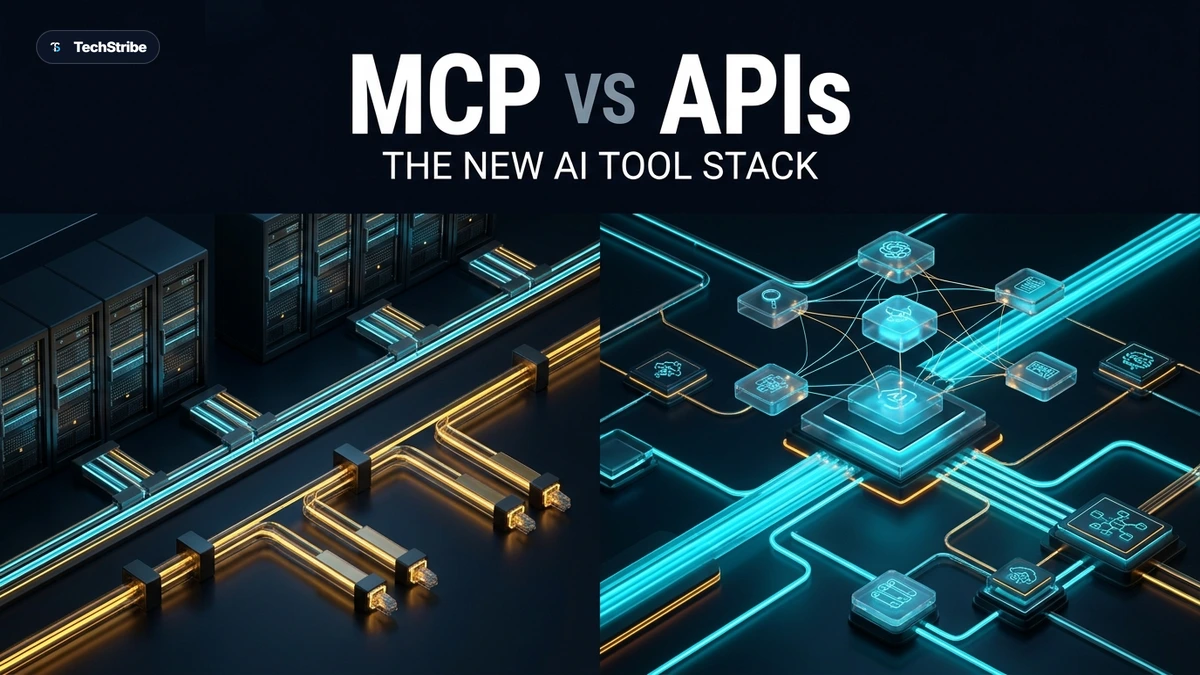
The Core Distinction: An API serves application code wired up in advance by developers. MCP serves AI models dynamically at runtime, standardizing tool discovery and context delivery—and usually wraps underlying APIs to execute actions.
Ask five developers whether you should use MCP or an API, and you will get five arguments. Most of them are answering the wrong question.
Here is a better mental model: an API is like the kitchen of a restaurant—it performs the heavy computational work and prepares the data. MCP is like a menu the AI can read on the spot, so it dynamically understands what tools are available to order. The menu does not replace the kitchen; it gives the intelligence layer an intelligible, standardized way to interact with it.
This guide explains the difference between MCP and an API in plain English, shows how they fit together, and helps you decide which architecture your system actually needs.
The Short Answer
In one line: An API is an interface for code that a developer wires up in advance. MCP is an open standard that lets an AI model discover and call tools at run time, and those tools usually call APIs behind the scenes.
| Dimension | Application Programming Interface (API) | Model Context Protocol (MCP) |
|---|---|---|
| Built For | Application code written by developers | AI models, through an AI application host |
| Who Decides What to Call | The developer at build time | The AI model at runtime, under user oversight |
| Replaces the Other? | No | No. It usually wraps an underlying API |
What Is an API?
An API, or application programming interface, is how one piece of software asks another to do something. A weather app asks a weather service for tomorrow’s forecast. An online shop asks a payment service to charge a card.
- Fixed Endpoints: Rigidly defined routes, such as
/v1/ordersor/v1/invoices. - Human Documentation: OpenAPI specs and developer portals written for people before code is authored.
- Deterministic Execution: A software engineer decides which calls happen and in what exact order.
- Status Code Errors: Responses return HTTP status codes (200, 404, 500) that application code branches on deterministically.
What Is MCP?
The Model Context Protocol (MCP) is an open standard that lets AI applications discover and use external tools, data, and prompts through one common interface. In modern agentic AI architectures, autonomous systems do not merely output static text—they dynamically orchestrate external tools at run time. Anthropic introduced MCP on November 25, 2024.
- Neutral Home: In December 2025, Anthropic donated MCP to the Agentic AI Foundation (AAIF), a directed fund under the Linux Foundation.
- Wide Ecosystem Support: Claude, ChatGPT, Gemini, Microsoft Copilot, Cursor, and VS Code support MCP across developer workflows.
- Built on JSON-RPC: Messages utilize simple, structured JSON-RPC requests and responses over standard I/O (stdio) or Server-Sent Events (SSE).
The Three Building Blocks of MCP
| Block | Who Controls It | What It Is |
|---|---|---|
| Tools | The Model | Executable functions the model can call, such as create_invoice, query_database, or search_issues. |
| Resources | The Application | Read-only contextual data, such as a file, git diff, or live customer record. |
| Prompts | The User | Reusable templates and structured workflows that users can select to guide model behavior. |
MCP vs API: Side by Side
| Dimension | Traditional API | Model Context Protocol (MCP) |
|---|---|---|
| Main Consumer | Application code written by a developer | An AI model, operating through an MCP client |
| Who Picks the Action | The developer, hard-coded at build time | The model, deciding dynamically at run time |
| How Capabilities Are Found | Documentation or an OpenAPI file read by an engineer | The client asks the server for its list of tools at run time |
| Interface Shape | Many fine-grained, granular endpoints | Fewer, task-shaped higher-level tools |
| Errors | HTTP status codes for code to handle | Natural language tool errors the model can read and retry |
| Cost per Call | Network and compute overhead | Network, compute, and model tokens for tool descriptions |
| Credentials | Held by your application code | Held by the MCP server, so the model never sees them |
Why fewer tools? Each tool description is text that the model has to read into its prompt window, which consumes context tokens. A well-designed MCP server offers a focused set of task-shaped tools rather than an exhaustive 1:1 mirror of every micro-endpoint.
How They Work Together: The Execution Flow
MCP sits comfortably on top of an API, not instead of it. Here is the typical runtime flow:
- The AI application connects to an MCP server at startup.
- The client asks the server which tools and resources it offers.
- The client passes those tool descriptions into the model’s active context.
- The model decides a tool would help accomplish the user’s prompt and produces matching arguments.
- The client delivers the structured tool call to the server.
- The MCP server performs the requested work, usually by calling an ordinary HTTP API.
- The result returns to the model, which synthesizes the outcome and continues the conversation.
Crucial Architecture Rule: The model never talks to external servers directly. The AI application sits in the middle, which is where permissions, security sandboxes, and human-in-the-loop approvals can be strictly enforced.
A Simple Example: Calendar Scheduling
| Component | With a Plain API | With MCP |
|---|---|---|
| Who Triggers It | A user clicks a “Book meeting” button in an app | A user tells an AI assistant, “Find a time with Sam next week and book it” |
| What Decides the Steps | Code the developer wrote and shipped in advance | The model, choosing dynamically between tools like find_free_time and create_event |
| What Does the Work | The calendar API endpoints | The same calendar API, called by the MCP server wrapper |
The calendar service itself did not change. MCP simply gave the assistant a machine-readable menu of what it could ask for, and the assistant picked what fit the user’s intent.
MCP vs Function Calling vs RAG
Two other foundational terms often get mixed up with MCP in agentic engineering:
| Term | What It Is | How It Relates to MCP |
|---|---|---|
| Function Calling | A proprietary model feature: the LLM returns structured parameters to run a described function. | MCP standardizes where those tools live and how they are discovered. Hosts often convert MCP tools into function calls behind the scenes. |
| RAG (Retrieval-Augmented Generation) | Retrieving relevant text chunks from a large knowledge store and injecting them into the prompt. | MCP lets the model take actions and attach known context, while specialized RAG (Retrieval-Augmented Generation) pipelines excel at indexing and searching vast unstructured document stores at scale. Production systems frequently deploy both in tandem. |
When to Use Each Architecture
| Engineering Situation | Best Fit |
|---|---|
| Your code calls a service in a predetermined, fixed order | A Plain API |
| One app, a few functions, single model provider | Function Calling (no protocol needed) |
| Many AI applications and agent tools should use your service | An MCP Server wrapping your API |
| The model dynamically decides which tool to use at runtime | MCP |
| Searching and summarizing across a massive library of unstructured documents | RAG |
If nothing in your system is an autonomous model choosing what to do next, you probably do not need MCP at all. A protocol engineered for dynamic discovery is unnecessary weight when nothing is discovering.
Key Trade-Offs to Plan For
- Extra Network Hop & Token Overhead: Every tool call adds a communication step, and tool schemas consume room in the model’s active context window.
- Server-Side Security Enforcement: Treat an MCP server like third-party software. Enforce strict permissions and input sanitization on the server rather than trusting a prompt to behave.
- A Rapidly Maturing Standard: The July 28, 2026 specification made MCP stateless, removing legacy handshakes and session IDs to allow MCP servers to sit behind standard enterprise load balancers. Verify which specification revision third-party tools target.
Related Reading & Deeper Context
- Securing MCP servers and AI tool connections — the 10-point checklist defending against MCP rug pulls and tool poisoning.
Frequently Asked Questions
What is the difference between MCP and an API?
An API is an interface for application code that a developer wires up in advance. MCP is an open standard that lets an AI model discover and call tools at run time, and those tools usually call APIs to do the actual work.
Does MCP replace APIs?
No. MCP usually wraps an existing API so an AI model can find and use it dynamically. The API still handles the underlying backend logic, storage, and processing.
What is an MCP server?
An MCP server publishes a catalog of tools, each with a name, description, and input schema. When called by an AI host, it executes the action by invoking internal functions or external APIs.
What is the difference between MCP and function calling?
Function calling is a model capability for requesting a function execution with structured arguments. MCP is an open protocol that standardizes how tools hosted across separate servers are discovered and connected.
Do I always need MCP to give an AI tools?
Not always. If one application uses a few static functions with a single model provider, direct function calling or a plain API integration is often simpler and lighter.
Which AI applications support MCP?
Claude, ChatGPT, Gemini, and Microsoft Copilot support MCP, along with developer environments like Cursor, Windsurf, and VS Code featured across our benchmark of the best AI coding tools.
Is MCP secure?
It depends on implementation. Best practices dictate treating MCP servers like untrusted third-party services: enforce strict role-based access, validate inputs, and never expose raw database credentials or unmonitored shell execution to model prompts.