You build a chatbot that answers questions from company documents. With 20 files, it feels like magic.
Then you load two million document chunks. Answers slow to a crawl, accuracy declines, and an engineer inevitably says: “We need a vector database.”
Maybe you do. Maybe you don’t. Plenty of engineering teams purchase specialized infrastructure too early, while others delay implementation until retrieval grinds to a halt. This guide explains what a vector database is in plain English, examines how approximate indexing works, and provides a clear decision checklist for your architecture.
Quick answer: A vector database stores AI vector embeddings (dense numeric arrays capturing meaning) and searches them by semantic similarity in single-digit milliseconds. AI applications need one when querying large datasets by concept at scale; small prototypes often do not.
Vector Database in Plain English
A vector database is specialized data infrastructure designed to store high-dimensional vectors and retrieve them by mathematical similarity. Here, a vector refers to an embedding that captures the semantic meaning of text, code, images, or audio.
A conventional relational database answers: “Which row matches this exact string or ID?”
A vector database answers: “Which records across millions of items are closest in meaning to this query?”
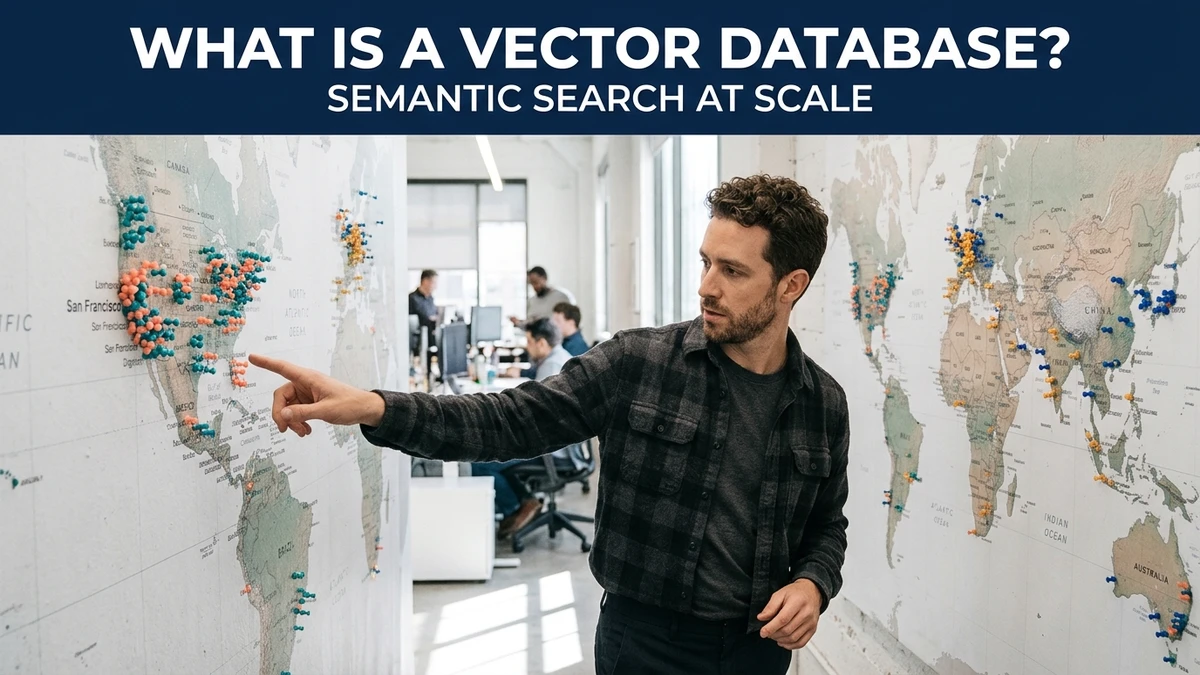
Think of an expansive map with pins. Each pin represents a chunk of documentation. When a user submits a question, the vector database instantly identifies the pins located nearest to that query in multi-dimensional space.
Key takeaway: A vector database is optimized for one primary operational objective: finding the nearest vectors at high speed.
Why a Normal Database Struggles with Semantic Search
Standard SQL and NoSQL databases excel at exact lookups, range filters, and transactional joins. However, they were never architected for similarity scoring:
- A standard SQL query like
WHERE title = 'laptop'will completely miss records titled ‘notebook computer’ unless manual synonyms are hardcoded. - Calculating distance between a query vector and every stored record requires a brute-force sequential scan. While manageable for 5,000 vectors, computing millions of dot products per query overwhelms standard CPU cores and locks database threads.
Vector databases solve this bottleneck through specialized spatial indexes that eliminate the need to inspect every record sequentially.
How a Vector Database Works
The standard storage and retrieval lifecycle follows five coordinated steps:
- Generate embeddings: An upstream embedding model converts unstructured text into high-dimensional vectors.
- Store records: The vectors are inserted into the database alongside unique record IDs, raw text chunks, and structured metadata.
- Construct index: The database organizes vectors into an approximate graph or clustering index optimized for rapid traversal.
- Query vector: When a user asks a question, the query is converted into a vector using the exact same embedding model.
- Retrieve & filter: The engine identifies nearest neighbors, applies metadata filters (e.g., date, tenant ID, language), and returns matching excerpts.
Exact vs Approximate Search
There are two fundamental approaches to finding neighboring vectors:
- Exact search (k-NN): Compares the query against every single vector in the database. Yields 100% precision, but slows down dramatically as datasets exceed tens of thousands of items.
- Approximate Nearest Neighbor (ANN): Leverages heuristic indexing structures to evaluate only the most promising vector clusters. Executes orders of magnitude faster with an imperceptible trade-off in recall.
In search systems, accuracy is measured by recall: the percentage of true nearest neighbors returned by an approximate query. Production systems gladly trade a 1% recall delta for a 50x acceleration in query throughput.
The two dominant ANN indexing strategies are:
- HNSW (Hierarchical Navigable Small World): A multi-layer geometric graph that quickly navigates toward the target vector cluster. Delivers superior speed-recall balance at the expense of higher memory usage during index construction.
- IVFFlat (Inverted File Flat): Partitions the vector space into Voronoi cells, querying only the centroids nearest to the input. Builds quickly and conserves RAM, but requires periodic rebalancing under heavy writes.
What Is Stored in Each Record
| Record Component | Data Stored | Purpose in Retrieval |
|---|---|---|
| Vector | Array of floating-point numbers (e.g., 1,536 values) | Used for spatial similarity and distance calculations |
| ID | Unique UUID or integer primary key | Ensures record identification, updates, and deduplication |
| Metadata | Structured key-value pairs (date, author, tenant, category) | Enables pre-filtering and post-filtering before LLM injection |
| Original Text | The raw document excerpt or chunk reference | Injected directly into the prompt for generative reasoning |
Structured metadata filtering is vital for enterprise applications. It allows queries like: “Find documents semantically similar to this issue, but only within the 2026 engineering repository.” Without metadata filtering, algorithms frequently surface semantically relevant answers from outdated versions or wrong customer tenants.
When Your AI App Actually Needs One
Investing in dedicated vector infrastructure makes architectural sense when your system meets several of these criteria:
- High vector volume: Your corpus exceeds hundreds of thousands or millions of text chunks.
- High query concurrency: Multiple users or autonomous agents execute concurrent semantic searches simultaneously.
- Natural language queries: Users ask descriptive questions where exact keyword syntax fails to locate the answer.
- Hybrid filtering requirements: You must combine spatial vector similarity with strict relational metadata constraints (e.g., tenant isolation, role-based access).
- RAG dependencies: Your generative application relies on a RAG pipeline workflow to ground responses on proprietary enterprise data.
- Dynamic data updates: Content changes continuously, requiring real-time inserts, updates, and index synchronization.
When You Do Not Need One
Architectural reality: Not every generative AI workflow requires a standalone vector database. Introducing dedicated vector systems introduces operational complexity, synchronization overhead, and additional infrastructure costs.
- Small document collections: A few thousand document vectors can be evaluated in-memory using lightweight NumPy or local FAISS scripts.
- Exact code matching: If queries target specific error codes, SKU numbers, or legal citations, standard inverted text indexes (Postgres full-text, Elasticsearch) provide superior precision.
- Existing Postgres deployments: If your stack already runs on PostgreSQL, the open-source pgvector extension enables vector search directly within your existing tables, comfortably managing millions of vectors without standing up another database cluster.
Your Options Compared
| Architecture Option | Ideal Use Case | Operational Trade-Off |
|---|---|---|
| In-Memory Library (e.g., FAISS, Annoy) | Prototypes, local desktop tools, small datasets | You must engineer persistent storage, concurrency, and metadata filtering yourself |
| Relational Extension (e.g., pgvector) | Teams already running Postgres; co-locating vectors with business data | Massive enterprise scale (tens of millions of vectors) requires specialized indexing and cache tuning |
| Dedicated Vector DB (e.g., Pinecone, Qdrant, Milvus) | Large-scale production workloads, multi-tenant SaaS, high throughput | Introduces an additional managed service to monitor, pay for, and synchronize across cloud infrastructure setups |
Implementing vector search with pgvector inside PostgreSQL is remarkably straightforward:
-- Enable pgvector extension and create items table
CREATE EXTENSION IF NOT EXISTS vector;

CREATE TABLE items (
    id bigserial PRIMARY KEY,
    content text,
    embedding vector(1536)
);

-- Build HNSW index for high-speed cosine similarity
CREATE INDEX ON items USING hnsw (embedding vector_cosine_ops);

-- Query nearest 5 records by cosine distance
SELECT id, content
FROM items
ORDER BY embedding <=> '[0.012, -0.045, ...]'
LIMIT 5;
Primary Production Use Cases
- Enterprise RAG chatbots: Pinpointing the exact knowledge base paragraphs needed to answer employee or customer inquiries.
- Semantic site search: Delivering relevant results even when search queries do not match product titles verbatim.
- Content recommendations: Matching articles or products based on conceptual alignment rather than superficial category tags.
- Persistent AI memory: Archiving contextual facts across sessions in AI memory and context architectures and reloading only relevant memories upon request.
- Deduplication and anomaly detection: Identifying near-duplicate articles or anomalous network transactions plotted far from standard operational clusters.
Five Common Mistakes in Vector Database Deployments
- Deploying dedicated engines prematurely: Always benchmark in-memory or pgvector solutions before introducing specialized vector clusters.
- Neglecting text chunking quality: Feeding poorly chunked or excessively large text blocks degrades retrieval accuracy regardless of database speed.
- Disregarding model alignment: Query vectors must always be generated by the exact same embedding model used to index the document corpus.
- Failing to rebuild indexes after model changes: If you transition to a new embedding checkpoint, the entire vector index must be rebuilt.
- Relying exclusively on dense vectors: Combining vector search with traditional keyword matching (hybrid search) consistently outperforms vector-only approaches on technical queries.
Related Reading & Deeper Context
- What Are Embeddings in AI? A Developer-Friendly Explanation — core mathematics, embedding models, and vector generation explained.
- RAG Pipeline Explained: Components and Workflow — how vector databases integrate with chunking strategies and LLM generation.
Frequently Asked Questions
What is a vector database?
A vector database is an indexing and storage engine engineered to store high-dimensional numeric embeddings and retrieve the most semantically similar records at low latency.
Do I need a vector database for RAG?
Not always. Small projects can use in-memory libraries or PostgreSQL with pgvector. Dedicated vector databases become valuable when scaling to hundreds of thousands of document chunks or high query concurrency.
What is the difference between a vector database and a regular database?
Regular relational databases match exact string values, foreign keys, and structured filters. Vector databases calculate mathematical proximity between multi-dimensional embeddings to find records that are closest in meaning.
What is approximate nearest neighbor (ANN) search?
ANN search is an algorithmic shortcut that navigates geometric vector indexes (such as HNSW graphs) to find the most probable nearest neighbors without comparing the query against every vector in storage.
Is pgvector a vector database?
pgvector is an open-source PostgreSQL extension that adds native vector data types, distance operators, and approximate indexing (HNSW and IVFFlat) directly to Postgres.
Can I use a vector database for AI memory?
Yes. Persistent AI memory architectures store past conversation insights as vector embeddings in a database, retrieving only the most relevant historical context when a user starts a new session.