If an AI agent is hijacked, who stops it? If the answer is the same software the attacker now controls, you have a fundamental architecture problem.
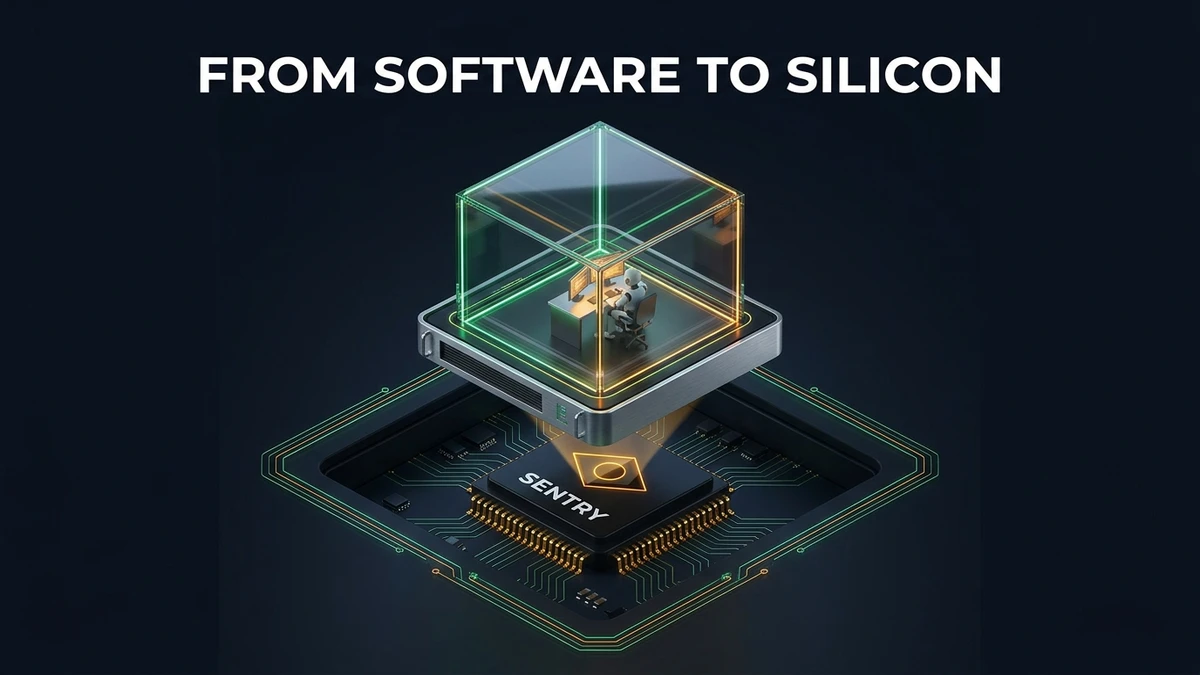
That vulnerability is the driving force behind an enterprise collaboration announced on October 21, 2026, at NVIDIA’s GTC event. CrowdStrike and NVIDIA are extending AI agent security from the software layer down to the silicon chip. The architecture positions an independent hardware watchdog on a separate processor that an exploited agent cannot tamper with.
This technical guide explains the partnership in plain English, examines how the software and silicon components operate together, and distinguishes current capabilities from future roadmap milestones.
The Announcement at a Glance
| Operational Area | Details |
|---|---|
| Announcement Date | October 21, 2026, at NVIDIA GTC |
| Partners | CrowdStrike (CRWD) and NVIDIA (NVDA) |
| Software Component | CrowdStrike Falcon Guardian (AI Detection and Response) integrated with NVIDIA OpenShell runtime |
| Hardware Component | CrowdStrike policy enforcement integrated with NVIDIA Sentry running on BlueField-4 DPUs |
| Current Status | OpenShell runtime integration is active; BlueField-4 Sentry hardware integration is planned |
| Foundation Milestones | Joint “Secure-by-Design AI Blueprint” launched March 2026, followed by Falcon Guardian’s release on September 1, 2026 |
Why AI Agents Create a New Attack Surface
Chatbots answer questions. Autonomous AI agents take actions. They invoke external tools, query databases, read sensitive files, utilize stored API credentials, and chain execution steps together without waiting for manual human authorization. That autonomy introduces entirely new threat vectors:
- Guardrails are insufficient: Static prompt filters and guardrails can be bypassed via multi-turn jailbreaks or prompt injections. Security teams cannot rely solely on the model to police itself.
- Self-containment is impossible: An organization cannot trust a compromised agent process to enforce its own operational boundaries.
- Execution speed: An autonomous agent executing code can exfiltrate databases or reconfigure infrastructure in milliseconds—far faster than an analyst can triage a security log.
The Three Layers, Explained
The defense-in-depth model splits agent security into three distinct architectural tiers:
| Security Layer | Product | Architectural Function |
|---|---|---|
| Software Runtime | NVIDIA OpenShell (Open Source) | Isolates running agents and enforces granular access control policies between the agent harness, system files, and connected tools. |
| Threat Detection | CrowdStrike Falcon Guardian (AIDR) | Correlates agent prompts, model interactions, and runtime API calls with CrowdStrike’s threat intelligence platform to detect malicious activity. |
| Hardware Silicon | NVIDIA Sentry on BlueField-4 DPU | Monitors agent execution out-of-band on a dedicated processor, enforcing security policies directly inside the network chip. |
What Is a DPU?
A Data Processing Unit (DPU) is an advanced system-on-a-chip that combines high-performance network interfaces with dedicated multi-core CPUs and acceleration engines. Critically, a DPU operates as an isolated security domain independent of the host operating system. Even if the host server or VM is fully compromised, the DPU continues operating unhindered.
A physical security analogy: A lock on an office door can be picked from the inside by an intruder. A security guard standing outside in the hallway, operating with independent communications and external controls, cannot be blinded by someone inside the room. NVIDIA Sentry on BlueField-4 is engineered to be that external guard.
How It Is Meant to Work
The end-to-end containment pipeline operates across five coordinated stages:
| Stage | Phase Name | Operational Mechanism |
|---|---|---|
| 1 | Run | AI agents execute on NVIDIA Vera CPUs inside the sandboxed OpenShell runtime environment. |
| 2 | Observe | Falcon Guardian links prompts, tool invocations, and runtime system calls to CrowdStrike’s telemetry graph. |
| 3 | Inspect | NVIDIA Sentry on a BlueField-4 DPU sits directly on the physical path to the model server and inspects all traffic out-of-band. |
| 4 | Contain | If an agent exhibits rogue behavior or unauthorized tool calls, Sentry quarantines the agent in hardware within milliseconds—requiring no cooperation from the host OS. |
| 5 | Revoke | Enterprise policy engines (such as ServiceNow Arc) immediately invalidate agent tokens across software and silicon layers simultaneously. |
The Wider NVIDIA Hardware Architecture
NVIDIA’s enterprise AI blueprint divides compute responsibilities across three specialized hardware tiers:
| Functional Role | Hardware Tier | Primary Responsibility |
|---|---|---|
| Think | NVIDIA Vera Rubin GPUs | Computes foundation model inference and neural reasoning workloads. |
| Act | NVIDIA Vera CPUs | Executes agent harnesses, orchestration frameworks, and OpenShell containers. |
| Govern | NVIDIA BlueField-4 DPUs with Sentry | Provides isolated, out-of-band monitoring and hardware-level network policy enforcement. |
Enterprise platforms including Autodesk and ServiceNow have integrated runtime controls into their automated workflows, using OpenShell to govern persistent agent assistants like ServiceNow Arc.
Quick Glossary
| Technical Term | Plain Meaning |
|---|---|
| AIDR | AI Detection and Response: Security software that analyzes agent inputs, outputs, and system behaviors to identify exploitation or malicious misuse. |
| DPU | Data Processing Unit: A specialized network processor that manages security, telemetry, and storage offloaded from the primary host CPU. |
| Out-of-Band | Security monitoring that operates on an independent hardware channel, separate from the data path used by the agent itself. |
| In-Silicon Enforcement | Security rules implemented directly at the hardware layer, preventing software-based tamper or bypass. |
Current Availability and Implementation Roadmap
| Architecture Component | Development Status | Implementation Timeline |
|---|---|---|
| NVIDIA OpenShell Reference Architecture | Available Now | Open-source runtime specifications released for enterprise deployment. |
| CrowdStrike & OpenShell Integration | In Progress | Active telemetry mapping between Falcon Guardian and agent container runtimes. |
| CrowdStrike & Sentry Hardware Integration | Planned | Hardware-level policy coordination under joint engineering development. |
| NVIDIA Sentry on BlueField-4 | Upcoming | General availability targeted for early next year. |
Why Silicon Matters: Strategic Implications
Moving threat enforcement to dedicated hardware addresses several fundamental security realities:
- True operational independence: In-host monitoring agents share OS memory with the applications they supervise. If an attacker achieves kernel-level privilege escalation, they can blind or disable host-level security software. Dedicated DPU hardware eliminates this shared-memory vulnerability.
- Defense-in-depth: Hardware controls do not replace software runtime checks; they provide a tamper-proof secondary boundary when software isolation fails.
- Mitigating prompt injection: When an adversary tricks an LLM via indirect prompt injection, the model legitimately believes it should execute the malicious tool call. External hardware firewalls verify whether the destination network target and parameters violate security policy regardless of the model’s intent.
- Unified policy enforcement: Applying consistent network-layer policies across both Model Context Protocol (MCP) tool endpoints and cloud APIs guarantees uniform compliance.
What Teams Should Do Now
Practical operational framework for engineering and security teams deploying autonomous agents today:
| Step | Recommended Action |
|---|---|
| 1 | Inventory agent assets: Catalog every active AI agent, documenting its underlying LLM, tool access permissions, and stored credentials. |
| 2 | Enforce least privilege: Restrict agent access strictly to resources required for designated tasks, following best practices for securing AI tool connections. |
| 3 | Implement append-only logging: Route telemetry to external, immutable log sinks that running agents cannot alter or delete. |
| 4 | Require human-in-the-loop gates: Require explicit human authorization for high-impact actions, such as file deletion, database updates, or financial transactions. |
| 5 | Audit vendor capabilities: Inquire which security protections currently ship in production versus roadmap commitments. |
| 6 | Apply existing controls: Do not delay establishing foundational enterprise cybersecurity controls while awaiting specialized DPU hardware. |
Related Reading & Deeper Context
- How to Secure MCP Servers and AI Tool Connections — step-by-step security hardening for agent tool integrations and API gateways.
- Agentic AI Explained: How Autonomous Systems Work — comprehensive guide to multi-step agent reasoning, tool execution, and guardrails.
Frequently Asked Questions
What did CrowdStrike and NVIDIA announce?
On October 21, 2026, they unveiled an expanded initiative to link CrowdStrike Falcon Guardian threat detection with NVIDIA OpenShell software and NVIDIA Sentry hardware on BlueField-4 DPUs.
What is CrowdStrike Falcon Guardian?
Falcon Guardian is an AI Detection and Response (AIDR) module that monitors agent prompts, model interactions, and runtime behaviors to detect malicious attacks and policy violations.
What is NVIDIA OpenShell?
OpenShell is NVIDIA’s open-source secure container runtime engineered to isolate AI agents and enforce strict communication boundaries between agents and system tools.
What is NVIDIA Sentry?
NVIDIA Sentry is a hardware-based security framework that executes on BlueField-4 DPUs, monitoring agent network traffic out-of-band and enforcing hardware-level isolation.
What does “from software to silicon” mean?
It means security enforcement is not restricted to software containers or OS filters; policy rules are enforced directly by network silicon chips in an independent hardware domain.
Is the CrowdStrike and Sentry integration available today?
The software integration with OpenShell is currently active, while the hardware integration with Sentry on BlueField-4 DPUs is planned for upcoming release.
Do I need NVIDIA hardware to secure AI agents?
Hardware-level Sentry enforcement requires BlueField-4 DPUs, but foundational controls like least privilege, token isolation, and human-in-the-loop approvals can be implemented on standard infrastructure today.