Say you type the same request into two different tools: “Help me get more people to read my blog.”
The first tool replies in seconds with ten post ideas, a headline list, and a draft intro. Useful, but now it is your turn to do the work.
The second tool checks which of your pages are losing visitors, picks three to refresh, drafts the updates, and asks, “Ready to publish these?”
One gives you something to work with. The other does part of the work.
That gap is the heart of the debate around AI agents vs generative AI. This guide explains the difference in plain language, shows how the two fit together, and helps you choose the right one.
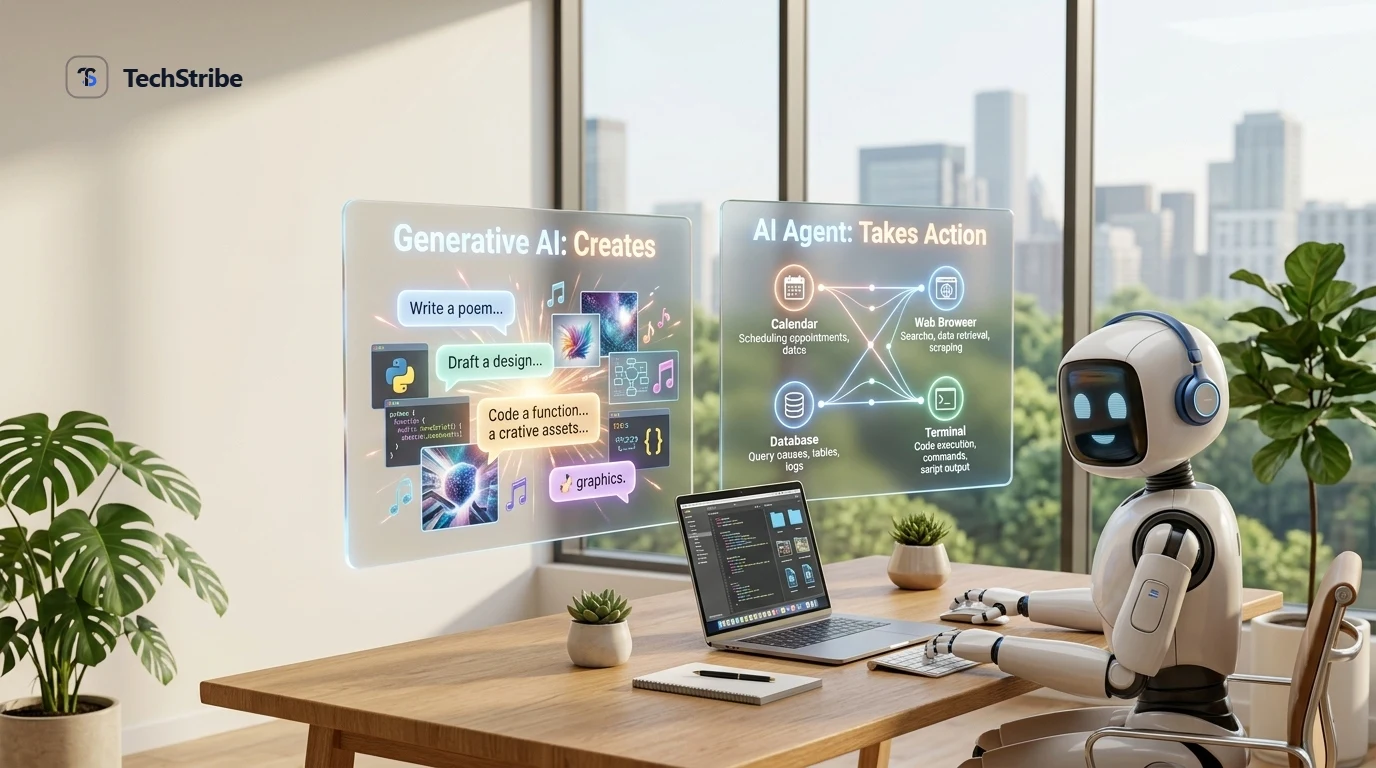
Generative AI creates content when you give it a prompt.
An AI agent works toward a goal by planning steps, using tools, and taking action.
They are not rivals. Most agents use a generative AI model as their reasoning engine.
What Is Generative AI?
Generative AI is a type of artificial intelligence that creates new content, such as text, images, audio, or code, based on patterns it learned from large amounts of training data. IBM Research describes it as deep-learning models that can generate high-quality content from the data they were trained on.
You give it a prompt, and it gives you an output. Chat assistants, image generators, and code assistants are all familiar examples.
Behind the scenes, three stages are at work: the model is trained on large amounts of data, you give it an instruction, and it generates a response that fits the patterns it learned. Each prompt starts a fresh response, so you stay in the driver’s seat from start to finish.
Where it falls short: it responds. It does not decide what to do next, and it cannot act in other software unless something else connects it. It can also sound confident while being wrong, so important facts need checking.
What Is an AI Agent?
An AI agent is a system that uses an AI model to pursue a goal. It decides the steps, uses tools such as search, code, or databases, looks at the results, and adjusts. Anthropic draws a useful line: in a workflow, developers write the path in advance, while in an agent, the model directs its own process and tool use.
Want the full basics? See our comprehensive guide on what an AI agent is.
AI Agents vs Generative AI: Side-by-Side
| Feature | Generative AI | AI Agent |
|---|---|---|
| Main job | Create content | Complete a goal |
| Starts with | A prompt | A goal or task |
| Steps | One response at a time | Multiple steps, chosen as it goes |
| Tools | Optional | Core to how it works |
| Human role | Writes prompts, reviews output | Sets goals and limits, approves key actions |
| Typical output | Text, image, code, audio | A finished task or changed system |
| Main risk | Wrong or made-up answers | Mistakes that compound, and actions with consequences |
| Cost and speed | Usually cheaper and faster | Usually costlier and slower, since it takes many steps |
The Same Task, Two Approaches
Consider the task: “Prepare this week’s sales summary for my manager.”
| Step | Generative AI | AI Agent |
|---|---|---|
| Data Input | You paste in the figures manually. | It pulls the figures directly from your sales system. |
| Generation | It writes a clear summary. | It builds the summary and generates a simple chart. |
| Delivery | You format it and send the email. | It drafts the email and requests your approval to send. |
| Oversight | You do all the verification. | You check the result, and it logs each action taken. |
The agent saves effort, but only if its connections, permissions, and checks are set up well. The generative tool needs more of your time but fewer moving parts.
How They Work Together
Think of generative AI as the skilled writer and thinker, and the agent as the project manager who hands it work, gives it tools, and checks what comes back. Most agentic systems today use generative AI as their reasoning engine.
You set the task
Plans the steps
Reasons and writes
Fetch data, take action
Checked by you
Real-World Examples
| Generative AI Role | AI Agent Role |
|---|---|
| Drafting product descriptions from a short brief | A coding agent that writes code, runs tests, and fixes errors autonomously |
| Summarising a meeting transcript | A support agent that looks up an order and starts a refund request within set limits |
| Creating images for a marketing campaign | A research agent that gathers sources, compares them, and drafts findings for human review |
| Explaining a block of code in plain English | A site-audit agent that scans pages and drafts a list of fixes for an engineer to approve |
Notice the pattern: generative AI produces something for you to use. The AI agent carries out a chain of steps and hands the completed result back for sign-off.
Which One Do You Need?
| If you need to… | Best fit | Why |
|---|---|---|
| Draft, rewrite, summarise, or brainstorm | Generative AI | One output, quick to review |
| Follow the same fixed steps every time | Workflow automation | Predictable and cheaper |
| Complete varied multi-step tasks across tools | AI agent | It can adapt its steps as it goes |
| Handle high-stakes business actions | Agent with human approval | Keeps a person firmly in control |
Anthropic advises starting with the simplest solution and adding complexity only when you need it. Often, that means generative AI or a plain deterministic workflow first.
Risks and Guardrails
Each approach fails in its own way, so each needs dedicated safeguards:
- Generative AI: check facts and figures before you use them, and avoid pasting private or confidential data into tools you haven’t vetted.
- AI agents: give them the least privilege access they need, require approval before they send, spend, or delete anything, and keep an immutable log of what they did.
In both cases, test thoroughly on real-world examples before you rely on the output in production.
Three Common Myths
- “Agents replace generative AI.” No. Agents usually depend on generative models as their underlying reasoning core.
- “Agents are always smarter.” Not necessarily. They can use the exact same foundation model. What they add is the capability to execute actions, which also introduces operational risk.
- “Anything labelled an agent is an agent.” Be careful. Industry analysts warn about “agent washing,” where basic chatbots and standard automation scripts are relabelled as agentic. True agents dynamically plan and adapt their execution path.
Related Reading & Deeper Context
- Agentic AI architectures — how autonomous planning loops, memory, and tool calling operate.
- Model Context Protocol (MCP) — how MCP standardizes live tool and data connections for AI models.
- The AI-driven ConnectWise supply chain campaign — why autonomous AI penetration tools demand tighter runtime guardrails.
Frequently Asked Questions
What is the main difference between AI agents and generative AI?
Generative AI creates content from a prompt. An AI agent pursues an overarching goal by planning steps, using external tools, and taking actions, often using a generative model to reason.
Is ChatGPT an AI agent or generative AI?
A basic chat conversation is generative AI. It becomes agentic when it can browse the web, write and run Python code, execute function calls, and carry out multi-step tasks on its own.
Can an AI agent use generative AI?
Yes. Most AI agents use a generative model (like Claude, GPT-4o, or Qwen) to understand instructions, break down problems, and draft outputs. The agent harness adds memory, tools, and execution loops around it.
Which is better for business: generative AI or AI agents?
It depends on the task. Generative AI suits drafting and fast content creation. AI agents suit multi-step workflows across applications with human approval for sensitive steps.
Are AI agents riskier than generative AI?
Yes, because agents can execute actions (send emails, update databases, run code) rather than just outputting text. Setting strict permissions, human-in-the-loop approvals, and audit logging is essential.