For a few years, AI mostly lived in a chat box. You typed. It answered. That was the whole deal.
At NVIDIA GTC Berlin 2026, the message changed. AI is moving to the factory floor, the road, the hospital, and the laptop on your desk. If you work in tech, run a website, or study computer science, this shift affects what you learn and what you write about next.
Here is a simple guide to what NVIDIA showed, and what you should take from it.
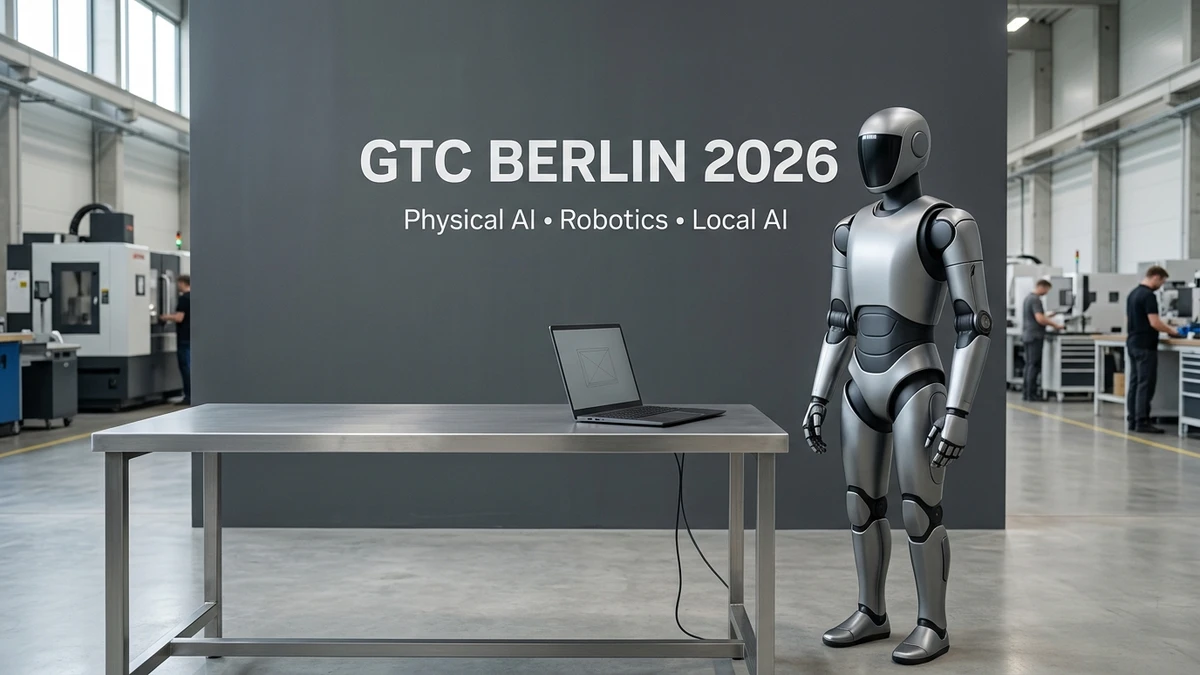
Quick summary: GTC Berlin ran from October 20 to 22, 2026. A major keynote delivered by Jensen Huang on October 21 at the Tempodrom highlighted three central pillars: physical AI, robotics, and local AI.
What Was GTC Berlin 2026?
GTC is NVIDIA’s AI conference for developers, engineers, and enterprise teams. The Berlin edition ran for three days and had more than 100 sessions on autonomous agentic AI systems, robotics, physical AI, open models, and accelerated GPU computing.
The pitch was aimed at Europe. Huang urged European companies to build AI using their strong factories, engineering skills, and their own proprietary industrial data. Europe leads in cars, precision machinery, and medical devices, providing a vast reservoir of real-world know-how that physical AI can learn from.
Physical AI: The Big Idea
Physical AI means AI that understands the physical world and can take actions in it. Think humanoid robots, self-driving vehicles, and automated factory machinery. Industry leaders describe this as the next major wave of artificial intelligence.
Why is physical AI hard? The real world is messy. A chatbot can guess a wrong word and try again in milliseconds. A robot arm cannot drop an expensive component and try again a million times on a live assembly line. That makes high-fidelity digital simulation essential.
Key takeaway: Chat AI works with words. Physical AI works with physical objects, spatial geometry, and strict safety constraints.
The Three-Computer Model Behind Robots
NVIDIA explained modern robotics architecture as a cooperative system of three computers:
- Train: One high-performance supercomputer trains the foundational AI model using massive compute clusters.
- Simulate: One computer lets the AI practise inside a digital twin built in Omniverse, creating a physics-accurate virtual copy of the real world.
- Run: One embedded edge computer sits physically inside the robot and executes the model live in real time.
Robots can learn countless tasks in simulation first, then deploy safely to physical factories. NVIDIA also shared its open physical AI stack, including Isaac Lab for simulation training and Project GR00T foundation models for humanoid intelligence. Industrial robotics leaders including Agility Robotics, Figure, KUKA, and NEURA Robotics are building on this shared platform.
Humanoid Robots: Agile ONE SN
The headline robotics demonstration was Agile ONE SN, a reference humanoid robot developed in partnership with Agile Robots. It operates on NVIDIA Isaac GR00T models paired with Jetson Thor AI hardware processors, scheduled for developer availability in early 2027.
A reference robot serves as a development foundation rather than a consumer device. It arrives preassembled with compute hardware and sensor software pre-integrated, enabling research labs and enterprise developers to begin building task-specific workflows immediately.
Robotaxis and Real-World Use Cases
Autonomous robotaxis represent the first large-scale commercial deployment of robotics and physical AI. NVIDIA’s Hyperion autonomous driving platform serves as the core stack across several major partner initiatives:
- Bolt: Plans to deploy NVIDIA’s Alpamayo autonomous stack in at least 25,000 future Lucid vehicles across Europe, with initial fleet data collection starting in Madrid from 2027, subject to regulatory approval.
- Uber: Building a dedicated autonomous data factory with NVIDIA, leveraging Cosmos foundation models to train next-generation self-driving fleets.
- Healthcare: Partnering with Siemens Healthineers to demonstrate adaptive radiotherapy, where real-time vision models track subtle anatomical shifts in a patient’s body and dynamically adjust radiation targeting.
- Industrial automation: Siemens is integrating AI agents into its industrial automation suite, while Audi utilizes digital twins to test factory production layouts and robotic assembly cells prior to physical construction.
Open Models: The Brains Behind It All
Hardware requires optimized neural weights to operate. NVIDIA highlighted a suite of open foundation models designed for distinct domain tasks:
- Nemotron: Optimized language and agentic reasoning tasks.
- Cosmos: World foundation models that enable systems to comprehend physical mechanics and 3D space.
- GR00T: Multimodal embodied intelligence tailored for humanoid robots.
- Alpamayo: Specialized vision and motion planning for self-driving vehicles.
- Earth-2: Physics-based models for high-resolution weather forecasting and climate simulation.
For engineering teams, this open model approach eliminates the need to build foundational architectures from scratch. Teams can adopt an open checkpoint and fine-tune it on proprietary domain data.
Local AI: RTX Spark, DGX Spark, DGX Station
The third major theme focused on local AI: executing models directly on desktop workstations and laptops rather than relying exclusively on centralized cloud computing infrastructure. NVIDIA unveiled three hardware systems:
| System | Who It Is For | Key Specifications |
|---|---|---|
| RTX Spark | Everyday professionals, engineers, and creators on Windows | Laptops from ASUS, Dell, HP, Lenovo, Microsoft, and MSI. Features up to 128GB of unified memory and 1 petaflop of local AI compute. Starting at $2,399. |
| DGX Spark | Developers and researchers on Linux | Multi-node linking via NVIDIA Sync now supports up to eight units clustered together. A 64GB entry version arrives October 23. |
| DGX Station | Enterprise AI engineering teams on Linux | Quiet desk-side system for heavy fine-tuning and inference workloads. A dedicated Windows edition is scheduled for December. |
NVIDIA also spotlighted the Underdog Desktop Agent, a software runtime that executes agent workflows locally so personal data never leaves the workstation.
Why Local AI Matters
- Data privacy: Sensitive internal files, source code, and customer records remain strictly on local silicon.
- System control: You select the exact open-weight model and runtime settings. Many RTX Spark laptops ship with unlocked bootloaders specifically for developers running local AI on Windows.
- Reduced cloud dependency: Deploying local language models eliminates recurring API token costs and protects against network outages.
- Hybrid architecture: Keep fast, private tasks local while routing massive batch jobs to cloud clusters.
Operational consideration: Local AI hardware remains bounded by physical VRAM and active context constraints. Sizing workstation memory carefully using our LLM VRAM calculator ensures your local models fit comfortably alongside OS tasks.
Announcements at a Glance
| Topic | Announcement Details | Timeline |
|---|---|---|
| Agile ONE SN | Reference humanoid robot powered by GR00T and Jetson Thor | Early 2027 |
| Bolt Robotaxis | Fleet of 25,000+ L4-capable autonomous vehicles planned in Europe | Data collection begins 2027 |
| RTX Spark | Windows PC hardware platform for local AI agents | Launched October 16 |
| DGX Spark 64GB | Lower-memory entry workstation for Linux developers | October 23 |
| DGX Station (Windows) | Enterprise desk-side supercomputing system for Windows | December |
Related Reading & Deeper Context
- AI Hardware Engine: Modern Accelerators Compared — breakdown of specialized tensor silicon and robotics edge processors.
- What Is a Local LLM? Why Run AI Models Locally — why local model execution protects data privacy and eliminates recurring API fees.
Frequently Asked Questions
When was NVIDIA GTC Berlin 2026?
The conference took place from October 20 to 22, 2026, with the opening keynote delivered on October 21 at the Tempodrom venue in Berlin.
What is physical AI?
Physical AI refers to artificial intelligence models capable of perceiving, navigating, and manipulating the physical world, including autonomous vehicles, industrial robotics, and humanoid systems.
What is NVIDIA RTX Spark?
RTX Spark is NVIDIA’s hardware specification for Windows AI PCs and laptops, featuring up to 128GB of unified memory and 1 petaflop of local AI processing power, starting at $2,399.
What is the difference between DGX Spark and RTX Spark?
RTX Spark targets Windows professionals and creators deploying personal desktop agents, while DGX Spark runs on Linux and is designed for developers clustering multi-node systems to build and train AI applications.
What is the Agile ONE SN humanoid robot?
Agile ONE SN is a preassembled reference humanoid robot developed by Agile Robots using NVIDIA Isaac GR00T foundation models and Jetson Thor compute, scheduled for developer release in early 2027.
What is local AI?
Local AI refers to running language models and intelligent agents directly on your own physical computer or workstation rather than streaming queries to remote third-party cloud servers.